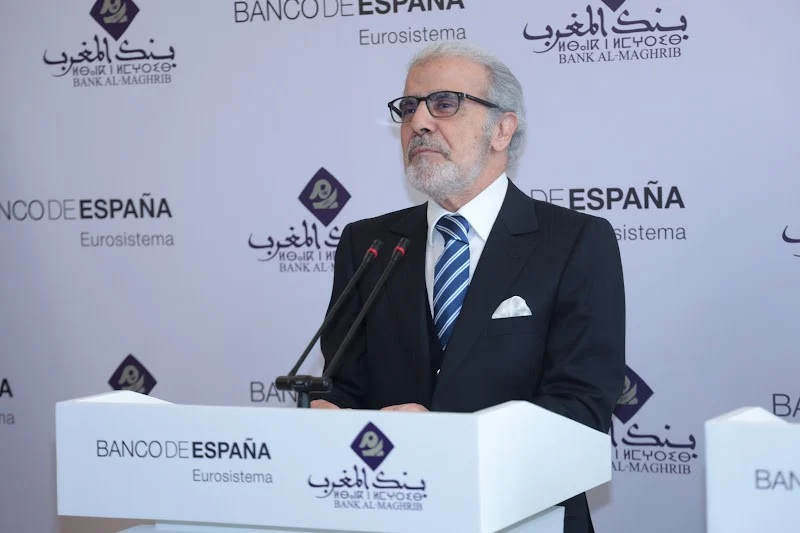
At his traditional press briefing on Tuesday March 19, the Wali of Bank Al-Maghrib discussed the country’s economic situation and the various economic projects underway.
In particular, he cautiously discussed preparations for the abandonment of pegging to the basket of currencies.
He also returned to the subject of the secondary market for outstanding debts, hoping to see the project completed by the end of the year. end of the year.
The Central Bank has decided to keep the key rate unchanged at
unchanged at 3%, a decision widely anticipated by the market. by the market.
At the press briefing that followed the decision, Jouahri explained the decision and engaged in the usual question-and-answer session with journalists.
In particular, he talked about the major projects underway, such as the secondary market for outstanding debts, the inflation-targeting regime and the general economic situation in the kingdom.
“This year, the IMF said of Article 4: ‘The current monetary policy stance is appropriate. BAM’s pause in monetary tightening since March 2023 is justified. With inflation returning to pre-pandemic levels, BAM should resume its transition to an inflation-targeting regime. It’s conditional, the words are chosen. Firstly, I told them, on a technical level, we’re starting to take ownership of a lot of things. We have a perfectly functioning interbank market. Since March 2020, BAM has not intervened in the foreign exchange market. ”
The Central Bank Governor then expressed his “full” support for the government’s move to gradually remove public subsidies on butane gas, which is expected to be implemented gradually.
“In all honesty and without bidding, I am in favor of targeting, according to the approach that the government tends to adopt through the unified social registry and the national population registry to distribute direct social support,” said Jouahri, stressing that “the government measures taken to implement social support are all in the right direction.”
He went on to explain that “the measures taken by the government to implement social support are all in the right direction.
The BAM governor elaborated: “This is what allows the financial margin to be available to finance health coverage and the universalization and expansion of social protection to cover 22 million Moroccans,” he said, asking: “How will the government deal with this situation, because the ‘don’t give, don’t take’ approach is not possible and will lead to higher inflation rates.”
Jouahri praised the gradual increase in the price of gas (MAD 10 from April 2024), which the government is linking to direct subsidies for vulnerable social groups, noting that it is a “logical step” that will achieve the desired targeting of subsidies.
In response to a question on the subject, Jouahiri explained that “when subsidies are applied universally, everyone benefits from them, whether rich or poor, at a similar pace and level, which exacerbates class and social disparities.”
Following the first quarterly meeting of the bank’s board in 2024 on Tuesday, the senior bank official stressed the “importance and necessity of resorting to the gradual elimination of the clearing subsidy, given that it contributed to reducing inflation to 2.4%, according to the BAM’s 2024 forecast,” before explaining that “the government did not choose to remove the subsidy on butane gas to finance social protection all at once, but chose to apply it gradually.
Since the end of last year, the government has revealed its vision for the engineering and implementation of social support in Morocco, emphasizing that the state budget cannot afford to finance direct support for families while maintaining the full cost of the clearing fund, given the poor social equity of the current support system in terms of targeting the poor and vulnerable classes.
“We must weigh and scrutinize things in order to achieve the desired goals (…) If we do not take this measure, we will enter a “vicious circle,” regardless of whether there are manipulations in the distribution of subsidies and imbalances that could mar the delivery of direct subsidies to deserving groups,” Jouahri said, drawing attention to the fact that “the government will begin to gradually reduce subsidies on the remaining items in the clearing fund in a way that does not affect the purchasing power of Moroccan citizens.”
Reducing cash transactions
Jouahri raised the issue of “the continued preference of Moroccans to pay in cash at the expense of digital/electronic financial transactions.” He said it is “a subject of reflection within the structures of the Central Bank” to the extent that he has mobilized the bank’s research and studies departments to conduct in-depth studies and research to understand the factors influencing this phenomenon.
“In the past, it did not exceed 6% or 7%, which is acceptable given the demographic increase, but it is no longer acceptable as it has reached high percentages exceeding 11 percent,” he said.
In response to a question on the subject, Jouahri revealed “the importance of focusing the research and studies of Central Bank experts on this point to conduct an in-depth study that reveals the factors that push citizens to use cash.”
Jouahri who noted the “persistence and overlap” of possible explanatory factors for the increasing use of cash by Moroccans, listed “the spread of the informal sector, lack of trust, fear of taxes, and other factors that encourage citizens to use cash instead of electronic payments.”
He then called on the state to “encourage the use of digital currencies by offering incentives.”
The BAM governor stressed the need to further strengthen the means of “financial literacy” to be able to “promote financial awareness and sensitize citizens with information campaigns on the benefits of electronic transactions financially,” citing “the launch of campaigns in Darija and Amazigh languages for this purpose.”
The latest data from the Morocco’s Centra Bank showed that the use of cash by Moroccans reached a record high at the end of last year, with “the volume of money in circulation during the past year reaching MAD 354.8 billion, a growth rate of nearly 11% year-on-year.”
Non-performing debts
Regarding outstanding or non-performing debts, the BAM governor revealed that it remains “a very important issue,” emphasizing “a recent meeting on the subject that included a committee made up of all concerned parties.”
Given the “critical importance of this issue,” Jouahri said, he emphasized the inclusion of all stakeholders, “including the national banking system, financial performance institutions, relevant ministries, as well as the Tax Directorate.”
“We have taken into account the comments and observations of all relevant actors and interveners in order to achieve the gradual finalization of the resolution of the issue. We are in the last 100 meters.”
Saham’s SG acquisition
Jouahri conditioned the success of the acquisition of Saham Group, owned by former minister Moulay Hafid Elalamy, on the acquisition of Société Générale Maroc (SGM).
The governor explained that the sale of Société Générale de France’s shares to the Moroccan group is subject to the acceptance of the application for approval, which will be studied and the new investor’s project, its business model and the additional value proposed by the new investor.
Jouahri added that Law No. 103.12, relating to credit institutions and bodies considered equivalent to them, is clear about changes in the nationality or control of a credit institution or the nature of the operations it carries out, depending on the granting of a new accreditation that is requested and delivered according to the formalities and conditions established in the same law, stressing that the Bank is the body authorized to study and accept any license file for a new investor in the banking sector.
Saham intends to buy the shares of Société Générale de France, the leading banking group that owns 57 percent of the capital of Société Générale Maroc.
The value of the deal is estimated at MAD 8 billion, half of which will be paid directly by the Moroccan investor.
In addition, MAD 4 billion, or 400 billion centimes, will be paid by the Moroccan investor, with the rest to be paid through bank loans.
The BAM governor revealed a previous meeting with the head of the collective management of the French Société Générale, during which he informed him of the need to comply with the legal procedures regarding the transfer of share ownership to a new investor, explaining that he called on the French official to prepare well for any step before submitting a new license file to the Bank of Morocco, warning that obtaining any future license will require meeting a set of conditions.







add your comment
Terms of publication : Not to offend the writer, people, sacred things, or attack religions or the divine self, and refrain from racist incitement and insults.