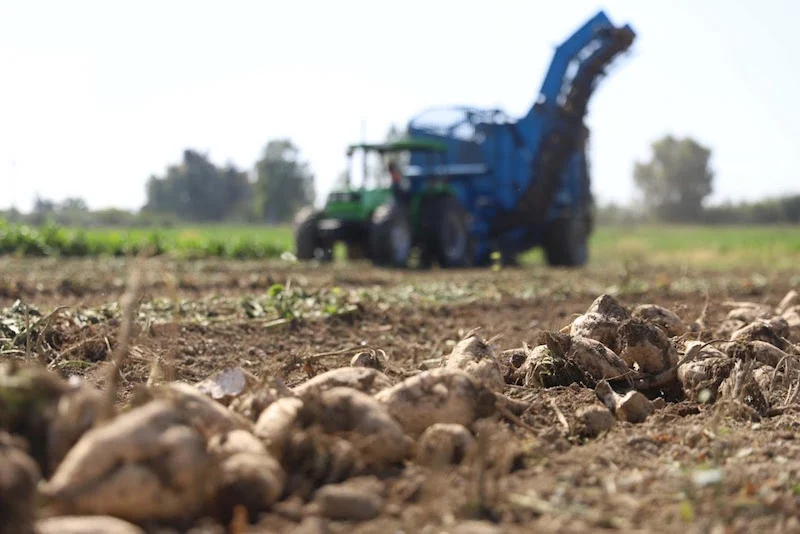
Despite suffering from a severe drought for years, Morocco remains a major exporter of vegetables and fruits, shipping millions of tons of produce to Europe, Africa, and other global markets annually.
This agricultural policy, however, has sparked criticism, as the country’s dams have dried up and groundwater levels have depleted. In addition, many argue that this policy only prioritized meeting the demands of foreign markets.
“Morocco is now exporting water through its agricultural products. This is extremely dangerous and is depleting the country’s stock of this vital natural resource, while also increasing economic dependence,” complained Najib Akesbi, an economist, in a statement to Hespress Ar.
He said, “any product, be it tomatoes, avocados, watermelons, or strawberries, consumes a significant amount of water. One hectare of these crops requires ten times as much water as a city. The 15,000 hectares of watermelons grown in Zagora, as an example, use about ten times as much water as the entire city of Zagora.”
Tomatoes export 21 billion liters of water:
Morocco’s agriculture and food processing exports are rising, with a total of more than 50 billion dirhams in January 2023. The country’s vegetable and fruit exports to Europe totaled more than 1.8 billion euros in September of 2023.
Tomatoes are the leading export, and their production demands a lot of water. According to the Moroccan Ministry of Agriculture, tomato exports last season exceeded 700,000 tons, which required 21 billion liters of water to produce.
Yassine Belharch, a farmer from Chtouka Ait Baha, a city falls under the Sous-Massa region, confirmed to Hespress AR that the region’s leading role in supplying year-round tomatoes to national markets.
He estimated, “20-25 cubic meters of water per hectare, requiring 25-30 liters of water to produce one kilogram of tomatoes.”
The farmer highlighted that the region counts on three water sources, namely, the Youssef Ibn Tachfine dam, groundwater from wells—which have recently required deeper digging for sufficient water supply—and seawater desalination.
Speaking of seawater desalination, Belharch underscored that this method is expensive and not accessible to all farmers as it requires 5.20 MAD/liter. In contrast, dam water costs only 0.80 MAD/ liter, and well water costs 1.5-2 MAD/liter.
Over the years, Morocco has exported increasing quantities of tomatoes, while the Youssef Ibn Tachfine dam, which irrigates key production areas, has seen a significant decline in its water reserves.
Hespress Ar reached out to the Ministry of Equipment and Water to inquire about the country’s water situation, but the ministry chose to remain silent despite the seriousness of the crisis.
No agriculture without export:
Farmers emphasized that exporting is essential for the continuity of their activity. According to Abdel Aziz Maanaoui, head of the Souss-Massa Farmers Association, producing one hectare of tomatoes costs 70-90 million centimes. Farmers encounter several challenges, including water scarcity and climate change.
In a statement to Hespress Ar, Maanaoui stated, “Moroccan products now compete with those of major countries like Spain, the Netherlands, and Germany. These exports are essential for the sustainability of the agricultural sector, preserving jobs, and ensuring food security and social peace.”
He underscored that “when discussing water exports, it is important to consider the full picture, not just focus on vegetables,” pointing out that “a kilogram of meat requires 200-300 liters of water, more than tomatoes.”
Despite tomatoes being the top exported agricultural crop, they are not the most water-intensive. Other fruits and vegetables need hundreds of liters of water to produce one kilogram.
Youssef Charhabil, an agricultural engineer and expert in fruit and vegetable production, seconded the aforementioned idea and explained that tomatoes and watermelons consume relatively little water, not exceeding 50 liters/kg.
However, he continued, fruits like avocados and bananas need over 300 liters/kg, while citrus fruits consume more than 250-300 liters of water.
The expert added that avocados are grown in the West region, where the water table is still available, so the production cost is lower.
Avocado exports on the rise:
On his part, Mohamed Derkaoui, an agricultural engineer and avocado producer, refutes the claim that avocados are responsible for water depletion.
“In our farm, we irrigate for six hours a day from late March to October. After that, we only water once a week or once every 15 days because there is no need for irrigation during the winter when the trees are not productive,” defended Derkaoui.
He went on to say that they extract about 30 tons of water per hour per day from the well, consuming about 7,000 to 7,500 cubic meters of water per hectare, excluding rainfall. This allows them to produce 15 tons of avocados per hectare.
Moroccan avocado exports have surpassed sales records for several consecutive seasons, quadrupling in the last six years. Last year, Morocco, the ninth largest global exporter of avocados, shipped over 45,000 tons of avocados, a volume that required 22.5 million cubic meters of water to produce.
“In 2023, Morocco exported 40,000 tons of avocados, valued at 80 million euros, using water equivalent to 57-60 days of water consumption by the population of Casablanca,” further defended Derkaoui.
Morocco imports 9 billion cubic meters of water:
Morocco’s Minister of Agriculture, Fisheries, Rural Development, Water, and Forests Nizar Baraka argued that the water crisis has been ongoing for years now, exacerbated by consecutive years of drought. However, He emphasized that water exports are not to blame.
In a statement to Hespress Ar, the Minister clarified that the country only exports 5% of the water it imports.
“In a regular year, Morocco imports 9 billion cubic meters of water for wheat, agricultural manufacturing, and other needs. Therefore, our total exports do not exceed 500 million cubic meters,” he argued.
Baraka further highlighted the need to balance food sovereignty to support the domestic market and the profitability of farmers while considering the impact on the workforce.
The Minister pointed out the importance of exports, but only after carefully calculating the benefits of each cubic meter of water consumed. He also talked about the importance of understanding the value of water resources in terms of labor employment and domestic market supply.
“The producer, aiming to provide significant outputs, must make personal investments to enhance productivity per hectare and ensure profitability in sales to sustain production,” explained the same speaker.
He went on to say that “even though avocados guzzle water, their cultivation area is minor compared to Morocco’s agricultural landscape. The Kingdom has 10 thousand hectares of land planted with avocados, out of a total of 1.6 million hectares of agricultural land in our country.”
Exporters also reject the blame for exacerbating the water crisis and demand effective solutions to safeguard their continued activity and maintain Morocco’s position in international markets.
“Addressing this issue involves a political aspect, emphasizing the need to strengthen exports and find effective solutions to the water crisis,” underscored Houceine Adardour, head of the Professional Federation of Vegetable and Fruit Producers and Exporters.
He said that exports should be strengthened, not halted, stating that agriculture employs over 30% of the Moroccan workforce and that ceasing exports would have a serious impact on the economy, including the availability of foreign currency, and the security of companies.
Aderdour argued that stopping exports would also harm Morocco’s longstanding reputation in international markets, built over 70 years, stressing the importance of coming up with effective solutions to address these challenges.
Green Morocco Plan under scrutiny of criticism:
Meanwhile, the Ministry of Agriculture rejected blame on the Green Morocco Plan, asserting it as the first strategy to value water usage and mitigate wastage, with studies targeting irrigation of 1.6 million hectares of agricultural land.
The minister also claims that climate change has had an enormous impact on Morocco and that the country has not received enough rain and snowfall in the last eight years to fill its dams and provide enough water for the water table. He described “the unprecedented situation as severe.”
He explained that water must be renewed and that it will evaporate if it remains in the dams for too long, stressing the necessity of seeking real solutions instead of blaming it on false information.
Baraka went on to emphasize the urgent need to move towards sustainable and unconventional water sources, such as seawater desalination and wastewater treatment.
He lamented the past delays, citing a water plan developed between 2010 and 2012 that remained unfinished.
“A royal directive was issued, when the current head of government was a minister, to establish a desalination plant in Ait Baha, with irrigation opened in 2022 for 15,000 hectares of tomato cultivation marketed domestically. Another program in Dakhla is still underway, set to irrigate 5,000 hectares by June 2025” noted the Minister.
“Studies have been initiated in TanTan, Essaouira, and the east, targeting sustainable irrigation covering between 100,000 to 120,000 hectares using desalinated water to ensure food sovereignty,” declared Baraka.
Climate change is predicted to exacerbate water crises, posing challenges for both irrigation and drinking water supplies. Thirst remains a looming threat to the future of Moroccan citizens, according to several studies.
Original piece: https://www.hespress.com/%d8%a8%d8%af%d9%88%d9%86-%d8%b9%d9%86%d9%88%d8%a7%d9%86-%d9%87%d8%b0%d9%87-%d8%a3%d8%b1%d9%82%d8%a7%d9%85-%d8%aa%d8%b5%d8%af%d9%8a%d8%b1-%d8%a7%d9%84%d9%85%d8%a7%d8%a1-%d8%b9%d8%a8%d8%b1-%d8%a7%d9%84-1311071.html





add your comment
Terms of publication : Not to offend the writer, people, sacred things, or attack religions or the divine self, and refrain from racist incitement and insults.