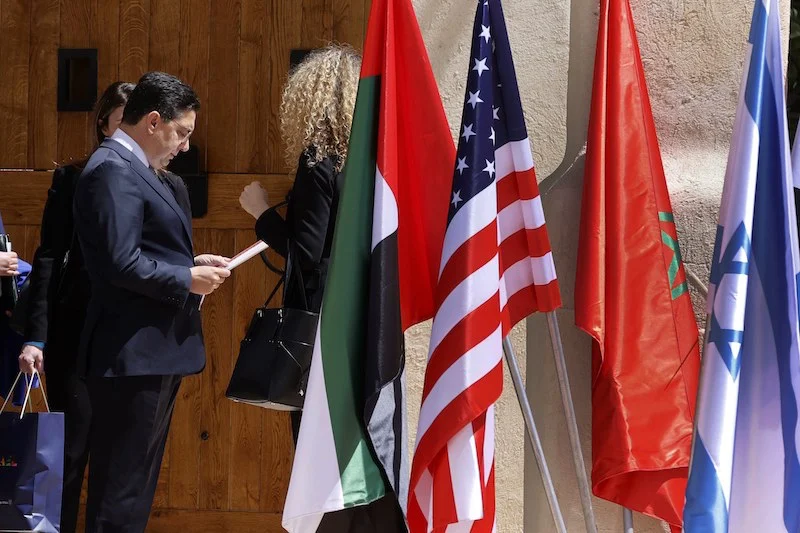
A paper published by American news outlet Media Line exploring Morocco’s coverage of the October 7 war noted a more neutral coverage among Morocco’s official media
A scholar in Moroccan Judaism and Moroccan-Israeli relation Mouna Izddine in her statement to the Media Line, emphasized the neutrality of official media and government-associated media in addressing the conflict, while simultaneously “reiterating the immutability of Morocco’s position on the political resolution of the conflict, namely the two-state solution.”
Despite the resonance of this trend in the Moroccan media landscape, it is worth mentioning that the majority of media outlets in the kingdom condemn, at the same time, the Israeli intervention and accuse Israel of deliberately targeting civilians, as highlighted by Izddine.
She also observed that very few media outlets acknowledged the October 7 surprise attack by Hamas against Israelis, and these outlets avoided categorizing Hamas as a terrorist group, describing it as a “resistance movement against a 75-year occupation.”
Izddine pointed out that the recent slump in Israel-Morocco relations during times of tension was not new.
However, the nature of their normalization, which was initiated by the United States and comprised American recognition of Morocco’s sovereignty over the Sahara, has “helped create a more solid base that will safeguard both countries’ relations,” emphasized the expert in Moroccan Judaism.
Einat Levi, a strategic advisor on Israeli-Moroccan relations and a researcher at the Mitvim Institute for Regional Foreign Policies also acknowledged the fact that Morocco has consistently supported the two-state solution and maintained a policy of neutrality during this war.
“It recognizes the PLO as the Palestinian representative, and actively sends humanitarian aid to Gaza; simultaneously, the country’s official position on its strategic interest in relations with Israel remains unchanged,” further explained Levi.
Morocco’s stance towards Israel, said the strategic advisor, was evident during the Arab Islamic Conference in Riyadh, where Morocco, along with other Arab and Muslim nations, refused to “endorse specific decisions or actions against their ties with Israel.”
The decision to keep the Moroccan ambassador in Tel Aviv is seen, in Levi’s view, as a significant statement in support of this position.
She suggested that Morocco, given its unique relations with both parties, presents an opportunity for regional and bilateral collaboration in the current crisis, as it “could play a crucial role in a broader coalition for rehabilitation and reconstruction processes.”
This includes implementing programs to address extremism and violence, training public employees in Gaza, and hosting forums to support and promote a sustainable solution to the Israeli-Palestinian conflict, suggested the strategic advisor.
Levi added, in a statement to the Media Line, that “the ties between Israel and Morocco are still strong, thanks to the solid base of mutual interests and shared values and culture.”
Given the ongoing situation in the Middle East, previous reports ruled out the possibility of Morocco retracting from the normalization agreement with Israel and its commitments with the US.
It additionally highlighted that Morocco’s foreign policy toward Israel is pragmatic, distinguishing between the country’s “religious and brotherly duty to support Palestinians” and its emphasis on “territoriality and economic development agenda.”




add your comment
Terms of publication : Not to offend the writer, people, sacred things, or attack religions or the divine self, and refrain from racist incitement and insults.