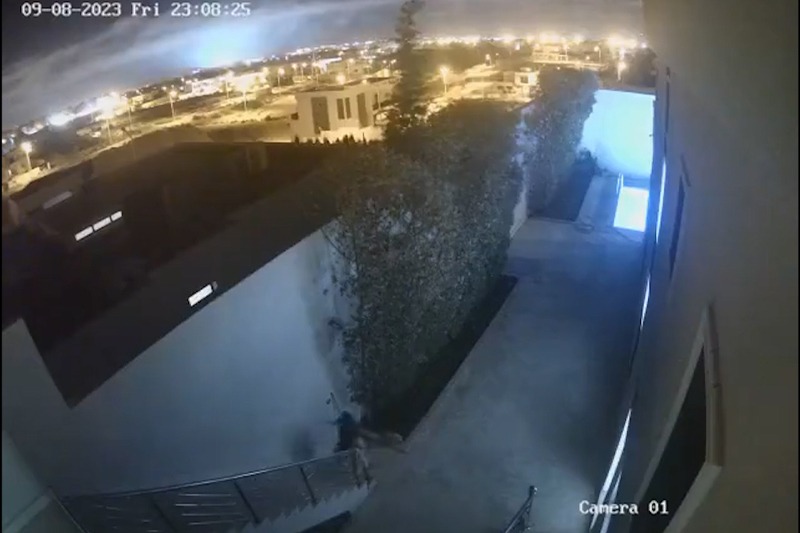
Lights were spotted before the earthquake of Morocco, resembling the mysterious phenomenon known as “earthquake lights” seen in videos prior to seismic events.
These luminous outbursts, which have puzzled scientists for centuries, date back to ancient Greece.
John Derr, a retired geophysicist who worked at the US Geological Survey, confirmed the reality of earthquake lights, although their exact cause remains a subject of debate.
Derr said that observing earthquake lights depends on darkness and favorable conditions.
Recent videos from Morocco showing these lights on security cameras during a 6.8-magnitude earthquake resembled similar phenomena observed during a 2007 quake in Pisco, Peru.
Advances in technology, like cell phones and widespread security camera use, have made studying earthquake lights more accessible.
Earthquake lights can manifest in various forms, such as resembling ordinary lightning, luminous bands in the atmosphere like polar auroras, glowing spheres in midair, or flickering flames on the ground.
Earthquake lights are most commonly associated with earthquakes of magnitude greater than 5.0, often occurring shortly before or during the seismic event, and visible up to 600 kilometers from the quake’s epicenter.
These lights were more likely to occur near rift valleys, regions where the Earth’s crust had been pulled apart in the past, creating lowland areas between elevated land blocks.
To better understand earthquake lights, Derr and his colleagues gathered information on 65 American and European earthquakes associated with trustworthy reports of earthquake lights dating back to 1600. They shared their work in a 2014 paper published in the journal Seismological Research Letters.
The researchers found that some 80% of the EQL occurrences studied were observed for earthquakes with magnitudes greater than 5.0. In most cases, the phenomenon was observed shortly before or during the seismic event, and it was visible up 600 kilometers from the quake epicenter.
Earthquakes, particularly powerful ones, are most likely to occur along or in the vicinity of the areas where tectonic plates meet.
However, the 2014 study found that the vast majority of earthquakes linked to luminous phenomena occurred within tectonic plates, rather than at their boundaries.





add your comment
Terms of publication : Not to offend the writer, people, sacred things, or attack religions or the divine self, and refrain from racist incitement and insults.