
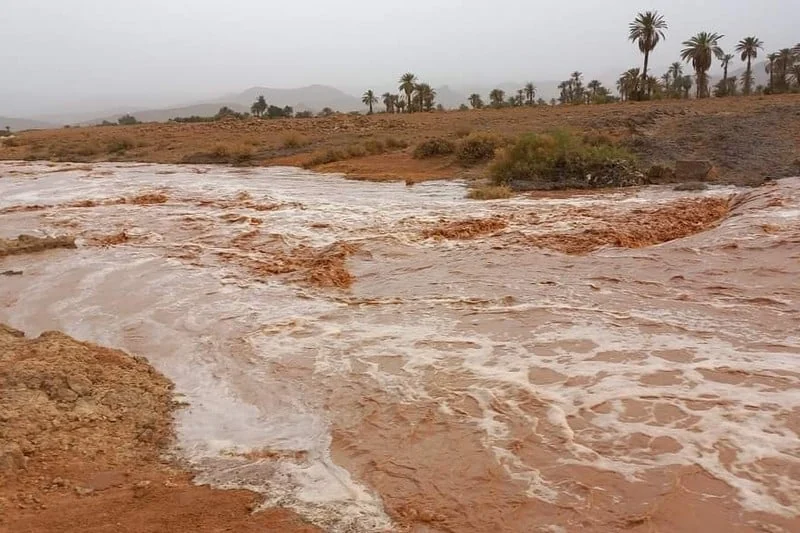
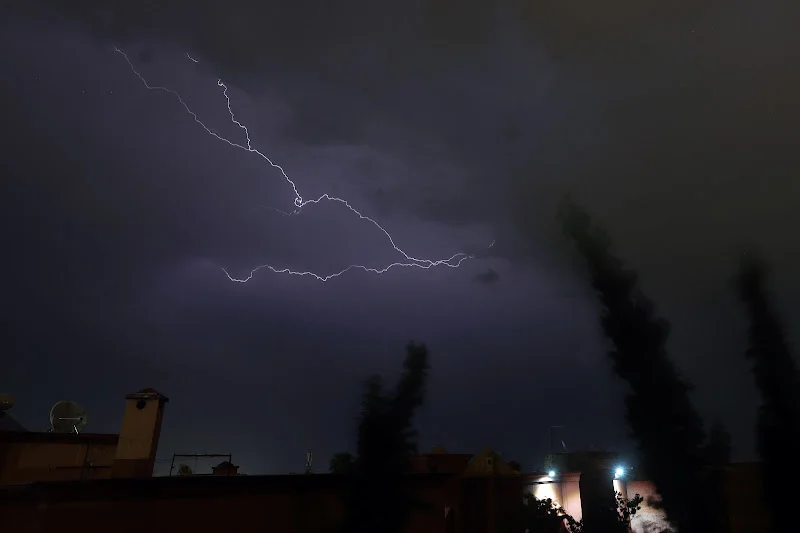
Meteorological conditions in Morocco have been marked by a period of relatively humid tropical weather accompanied by the formation of unstable clouds. The impact has been particularly felt in the Atlas highlands, as well as the northern and central regions of the country, resulting in intermittent rain showers accompanied by thunderstorms.
The General Directorate of Meteorology, a division under the Ministry of Equipment and Water, has confirmed that this weather pattern is attributed to the approach of an air depression from the Atlantic Ocean. As a result, a southwestern current has formed, bringing a cluster of moisture-laden and unstable clouds that have affected various parts of the country, notably the north and center, resulting in varying levels of precipitation.
In the past 24 hours, precipitation measurements have been recorded in several locations across Morocco. Taourirt experienced 41 mm of rainfall, while Fez received 12 mm, Tetouan 10 mm, Kenitra 9 mm, and Benslimane 8 mm. Mohammedia and Tangier recorded 7 mm, Al-Bayda 6 mm, and Tit Mellil and Oujda received 5 mm. Rabat, Nador, Tiznit, and Nouaceur each had 3 mm of rainfall. Agadir-Inezgane and Khouribga reported 2 mm, while Midelt, Chefchaouen, and Taza received 1 mm. Less than 1 mm of rainfall was recorded in Essaouira, Taroudant, Larache, Sidi Ifni, Agadir-Al Massira, and Benkirir.
According to information obtained by Hespress from the Directorate, these weather fluctuations are typical during the transition from spring to summer in Morocco. This period often experiences significant variations, characterized by low rainfall primarily in the form of thunderstorms, particularly in mountainous regions.
Climate expert Mohamed Benabou confirmed the climate fluctuations being experienced in Morocco. He referenced a recent report by the Association of Climatologists, which highlighted that similar thunderstorms occur in various regions worldwide.
Benabou further explained that this situation is characterized by delayed rainfall and the occurrence of thunderstorms or heavy rains during these months. He emphasized the negative impact of these weather events, which can also be observed in other regions globally and may increase in intensity in the coming years.
These findings were also supported by a European Union-affiliated organization monitoring global climate conditions. Morocco and the African continent, according to the organization, are currently experiencing severe climate changes resulting in delayed rainfall until the months of May and June, which are often accompanied by stormy weather. While this benefits water reserves and reservoirs, it has adverse effects on the agricultural season, particularly for spring and summer crops.





add your comment
Terms of publication : Not to offend the writer, people, sacred things, or attack religions or the divine self, and refrain from racist incitement and insults.