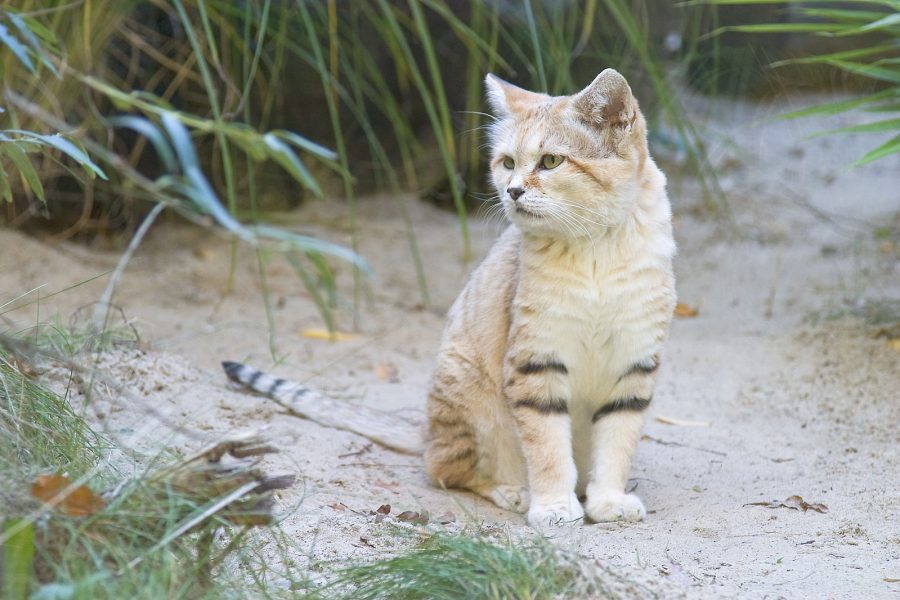
Scientists from the Rabat and Cologne Zoos collaborated with Panthera, an organization dedicated to the conservation of wild cats, on a multi-year study that provided crucial new insights into Morocco’s sand cats.
The experts said that it might be appropriate to change the species’ conservation status to “Near Endangered,” reports Treehugger Media.
Sand cats gained enormous popularity in 2017 after images of the tiny wild felines from a study by Grégory Breton, managing director of Panthera France, went viral online.
The small felines can weigh up to 7.5 pounds, and resemble small house cats in appearance.
However, these are wild cats that have evolved to survive in some of the most extreme environments on earth.
Situated in Africa’s Sahara Desert and the Arabian Peninsula, Felis margarita is the only feline to live completely in deserts, revealed Treehugger media.
After tracking 22 sand cats with VHF radio collars and intermittently following and observing them in southern Morocco between December 2015 and December 2019, they discovered that sand cat ranges are much more extensive than previously thought.
“Incredibly, they rival ranges of much larger cats like leopards and tigers, with one sand cat covering an area of up to 1,758 square kilometers (about 1,093 square miles) over 6.5 months,” explains Panthera.
Currently, scientists think that sand cats, which include black-footed cats and African wildcats, probably preserve the broadest range of cats in their Felis species.
The same article indicated that the researchers faced numerous difficulties due to the harsh desert environment, the equipment’s limitations, and the cats’ elusiveness.
According to the study’s findings, these charismatic carnivores could not rely on well-defined home ranges but rather maintain a somewhat nomadic lifestyle, shifting their location based on factors like changes in rainfall.
“If true, this type of movement in response to rainfall is previously unrecorded among wild cat species,” declared Panthera.
All of the sand cats the authors saw in the area had healthy outward appearances, with few to no scars, no broken teeth, and no signs of injuries.
According to the study, sand cats are likely non-territorial and tolerant of one another. Their social structure and mating behavior are mostly unknown, and their ecology is still rather small.




add your comment
Terms of publication : Not to offend the writer, people, sacred things, or attack religions or the divine self, and refrain from racist incitement and insults.