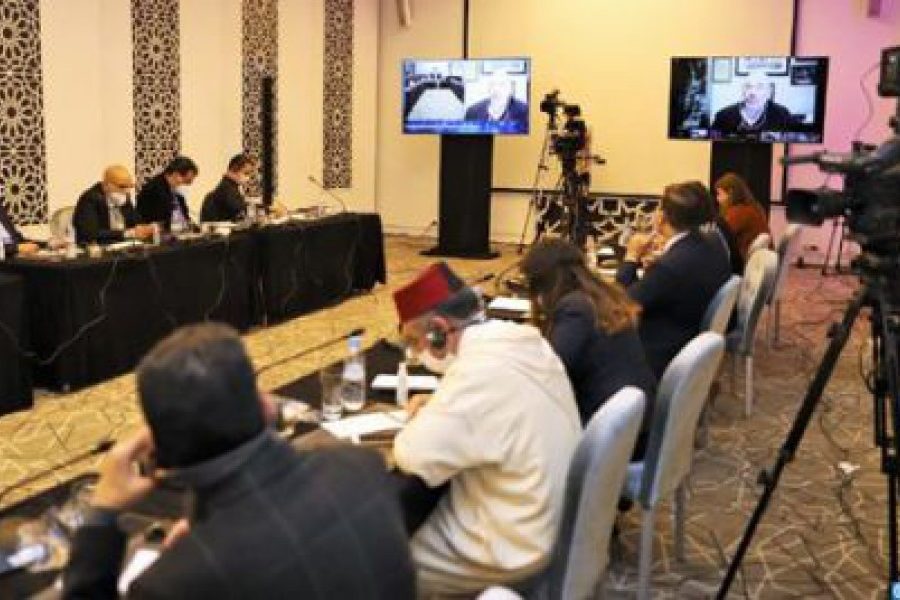
Morocco has adhered since 2003 to the process of combating terrorist crime and its repercussions, through the adoption of a proactive policy backed by legislative provisions, which has helped foil several terrorist cells and devastating operations, said, Tuesday in Rabat, the divisional commissioner of the anti-terrorist section at the Central Bureau of Judicial Investigation (BCIJ), Mohamed Nifaoui.
Speaking at the Annual International Conference on “Fighting violent extremism: new responses to new challenges”, organized by the Moroccan Observatory on Extremism and Violence (OMEV) in partnership with the General Delegation for Prison Administration and Reintegration (DGAPR), the Policy Center for the New South and the Rabita Mohammadia of Ulema, Nifaoui noted that Morocco has managed since 2002 to dismantle a total of 209 terrorist cells, arrest nearly 3,535 people, and foil more than 500 devastating projects.
In this context, Nifaoui said that Morocco is a leader in this field, through its adoption of a preventive, anticipatory and comprehensive approach based on fighting extremism from its cradle, through monitoring the activity of terrorist extremist cells, trap its members and bring them to justice, as well as the strengthening of security surveillance at the various border points, the development of the security system to monitor the evolution of transnational terrorist crime, and the implementation of a set of legislations to accompany the risks of this phenomenon.
Among the measures taken by the Kingdom in this context, the official mentioned the procedures for developing and reviewing the management of the religious field and the prohibition of its use by groups and individuals, the concretization of the role of the Higher Council of Ulema, under the High Patronage of HM King Mohammed VI, the unification of “fatwas”, which are the exclusive specialty of the council, as well as the creation of the Mohammed VI Institute for the Training of Imams, Mourchidines and Mourchidates and the Mohammed VI Institute of African Ulema, in addition to the strengthening of criminal laws so as to enable the Kingdom to fight terrorism in a clear and direct manner.
In the same vein, Nifaoui noted that a number of terrorist organizations are taking advantage of the exacerbation of crises and fragile security situations in the Sahel and Sahara region of Africa to carry out their criminal plans, stressing that among the terrorist organizations that adhered to the implementation of the devastating project of the “Islamic state” of Daesh, there is an organization called “the Islamic state in the greater Sahara”, led by Adnane Abo Lwalid born in Laayoune, who is one of the members of the “polisario” front.
“This terrorist organization carried out several terrorist operations from 2016 to early 2020, targeting sites and joint military patrols involving local and international military in the countries of Niger, Burkina Faso and Mali, resulting in the destruction of several sites and many deaths and injuries,” he added.
In this regard, he called for a regional security approach to unite efforts to combat these terrorist organizations, especially in the context of the spread of weapons over vast unmonitored areas, and the receipt of large quantities of weapons and bullets from these organizations as a result of its relations with organized crime activists, in addition to its support by fighters belonging to the so-called polisario separatist front.
Nifaoui also warned that failure to combat the effects of this regional situation can lead to the creation of new hotbeds for the continuation of Daesh’s expansion plans, calling on countries in the region to fulfill their security and preventive roles, through intensified control measures at border points and the exchange of available information on fighters, their monitoring and transfer to their countries of origin.
He also recalled that Morocco has contributed to foiling several terrorist plans abroad, through coordination, joint cooperation, and exchange of information and expertise, noting that the Kingdom always sought to strengthen cooperation within the framework of South-South cooperation with other African countries, which it considers a strategic security and economic extension.





add your comment
Terms of publication : Not to offend the writer, people, sacred things, or attack religions or the divine self, and refrain from racist incitement and insults.