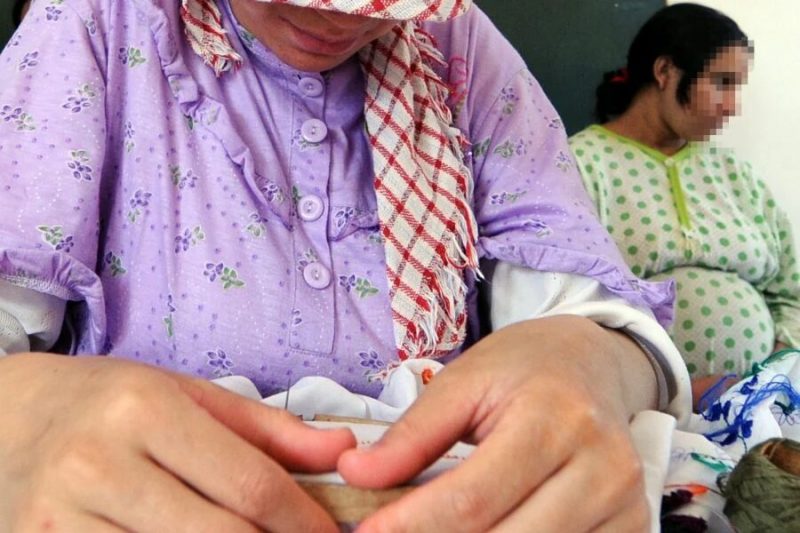
Meryam Saidi had relied on her dutiful spatial memory to carry her a few blocks to her doctor’s appointment. The journey from her home in Rabat, with her boyfriend glued to her side, had taken about 20 minutes. She arrived at a semi-lit, stoic clinic; faithful to the sensory and visual clichés of medical care.
Saidi let her feet carry her a little bit longer, onto the bed where she laid for about two hours, drugged out, the doctor removing an embryo from her womb in a secret ritual that otherwise would have turned into her biggest liability. She’s 20. She works minimum wages and her mental health is not in the right place.
“It’s for the best. I can’t have a child now,” she told herself, but within a different narrative crept. “How could you, how could you,” she’d say. “ Many women dream of this and look at you wasting it away, how could you look at yourself,”
She did look at herself, back home where she removed her blouse and jeans and wept for some time, bled, felt guilt, and her body ached at becoming one of 800 women in Morocco who undergo abortions daily.
Or at least this is what the data compiled in an informal study show – regurgitated by officials and media a decade after it was first issued by the Moroccan Association for the Fight against Clandestine Abortion, presided by Chafik Chraibi.
Chraibi, a self-possessed man and former chief of the maternity hospital where he was fired for being too vocal on abortion, based off the figure on a loose estimate that qualifies 10 cases of botched abortions making it to the hospital to 100 more being performed in secret.
Since then his name has become the go-to for journalists reporting on abortion. To Hespress EN, he prided himself on being the raison d’etre of a King’s order to constitute a committee that would study amendments to abortion law.
The committee proposed to Parliament a draft law that would legalize abortion in the case of rape, incest, and fetal malformation, or when there’s a danger to the mother’s health. This was 7 years ago.
With the coming of Morocco’s new Akhannouch-led government in October 2021, the draft was tossed out of the Parliament building – where just a few blocks away, Saidi was making her come back into society, to friends and work and her supportive boyfriend who stood by her throughout.
The dust had begun to settle. As it often does with issues rooted in local sensitivities.
New hope
Challenging these sensitivities is Touria Skelli of the Progress and Socialism Party who, alongside a team of parliamentarians, is trying to withdraw abortion from the penal code, where it is literally defined as an attack on morals and family values to an independent jurisdiction of its own.
She wants to introduce a Moroccan law on abortion and radically redefine what it means to have an abortion from a matter embedded in societal practices to a matter of health. By doing so, the right of women to abort would be expanded into considerations of their psychological and social health, as defined by the World Health Organization.
Her decade-long ambition is now merely a draft in the drawers of the House of Representatives – but she is hopeful that the liberal majority in Parliament would have more tolerance for it than their PJD predecessors – or at the least reinvigorate the discussion on abortion in the political arena.
Evidence shows that limiting women’s access to abortions has no effect on how many are performed. In reality, limitations are more likely to encourage women and girls to engage in risky practices.
Chraibi’s circle of doctors continues to receive women with vaginal prolapse, internal bleeding, tetanus, and severe poisoning.
Only one in four abortions are safe in nations with the strictest restrictions on the procedure, compared to nearly nine out of ten in countries where the procedure is generally legal, according to the WHO.
Without safe access to abortion, women use sewing needles and wire hangers, ingest potassium permanganate pills, toxic traditional herbs, and many more unsafe alternative measures, says Chraibi.
Chraibi presses for urgency as his 2009 estimate for the number of daily abortions is likely higher today. “As the population grows, and society and young women become more open-minded, today the number is probably higher.”
“We continue to fight in vain, it is several years of trial and error without satisfactory results,” Chraibi said. Having not been consulted in the drafting of the law, he maintained to Hespress EN that united efforts are better efforts.
This story was reported by Zaina Jnina, and written by Amira El Masaiti.






add your comment
Terms of publication : Not to offend the writer, people, sacred things, or attack religions or the divine self, and refrain from racist incitement and insults.