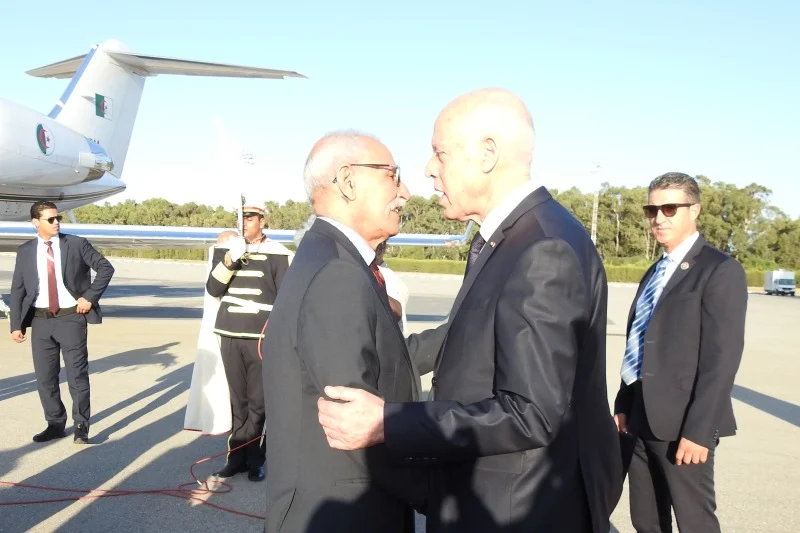
In an already divided Maghreb, Tunisian President Kaïs Saïed has deeply offended decades of the Moroccan-Tunisian history by unilaterally inviting Brahim Ghali, leader of Polisario to the Japan-Africa cooperation Forum (TICAD).
By his “hostile and reckless” act, Kaïs Saïd has just broken a doctrine that all his predecessors respected, from Zine-el-Abidine Ben Ali to former elected presidents, who made sure to maintain the Tunisian tradition of good relationships due to Morocco’s unwavering support for the Republic and its people over the years.
The historical ties between Morocco and Tunisia have continued to strengthen since the French colonization. In 1958, the late King Mohammed V convened the first conference of the Great Arab Maghreb in Tangier, where the Moroccan Independence Party and the Tunisian Constitutional Party joined their forces to get each other support and to coordinate their work and discuss the post-independence, especially after the bombing of air bases in Tunisia by the French air force.
Back in 1980, following the illness of the late Tunisian Prime Minister Hedi Nouira and the Gafsa event in Tunisia, the late King Hassan II declared his firm and steadfast military support where the Kingdom will be representing Tunisia and its people, when an elaborate armed raid orchestrated by Libya and Algeria was launched to overthrow the Tunisian regime.
The late king Hassan II expressed at the time that Morocco would not be satisfied with defending Tunisia by the press or the radio, but militarily.
“Tunisia will never be destabilized because it is first of all a people, and one does not destabilize a people”, he indicated.
Furthermore and despite the specter of terrorism that hanged over Tunisia after the “Arab Spring,” King Mohammed VI chose to be the first Arab leader to visit the “cradle of the Arab revolution” in 2014. This visit was one of his first trips outside the Kingdom, where he extended his stay for a period of 10 days for tourism.
The King’s walking tour was a message that security is stable in Tunisia and also came in support of the democratic transition, according to Tunisian observers.
The trip gave the impression that the Tunisian republic has managed to overcome the plight of “divisions and terrorism,” as the King traveled on tours, without heavy guards, and in sportswear, in the squares and markets of Tunis and on Bourguiba Street, or what became known in Tunisia as “Revolution Street.”
On October 23, 2019, a Moroccan delegation composed of the heads of both Moroccan parliament chambers became the first foreign delegation received by the new designated Tunisian president.
The delegation was assigned by the King to attend the event and congratulate Kaïs Saïd’s new position.
On July 26, 2021, King Mohammed VI sent Nasser Bourita, the Minister of Foreign Affairs to the Palace of Carthage, after Tunisia’s social and sanitary crises, and a day after Tunisian President’s decision to dismiss the head of government, freeze the work of the Assembly and declare a state of emergency, as a sign of solidarity and support.
In addition, the Moroccan sovereign set up an airlift during the COVID-19 crisis in July 2021, for a field hospital put in place in Manouba and medical aid delivered by the Royal Air Force in a moment when Tunisia was overwhelmed by the resurgence of the cases.
The medical aid included two resuscitation units with a total capacity of 100 beds, 100 respirators and two oxygen generators.
Throughout the post-independence decades, several partnerships in various fields were accomplished between both countries. The then-aim was to face common development and security challenges.
Tunisia succeeded then to maintain a neutral position on the Sahara conflict between Morocco and Algeria, and did not support one party at the expense of the other.
However, with Kaïs Saïd in power, Tunisia chose to side with the Algiers axis and strike the interests of the Kingdom despite the long term relationship.







add your comment
Terms of publication : Not to offend the writer, people, sacred things, or attack religions or the divine self, and refrain from racist incitement and insults.