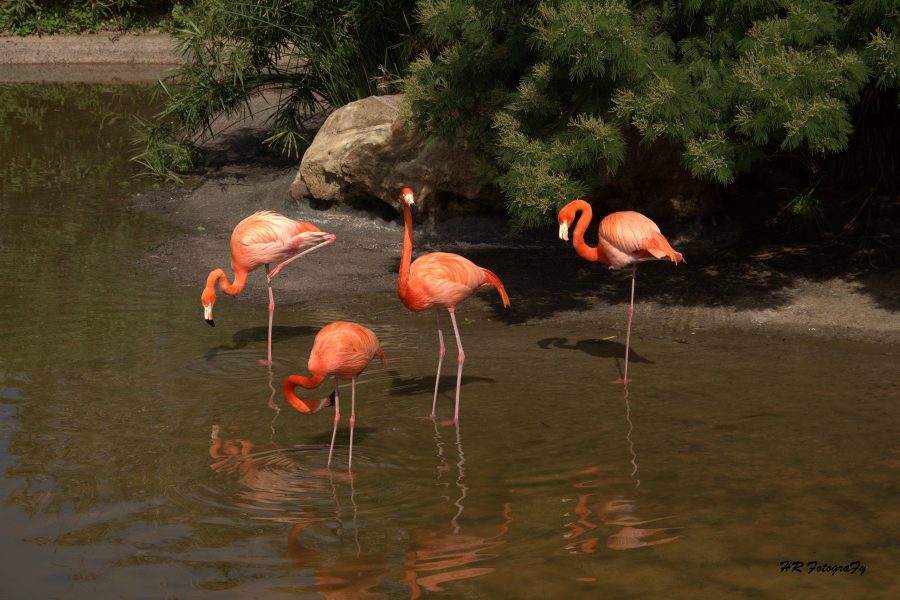
Scientists in Morocco set a new breeding strategy to get greater flamingos to breed in Khnifiss lagoon, located between the cities of Tantan and Terfaya.
The scientists constructed fake nests to monitor the flamingos closely and prohibited access to the site to limit disturbance for the long-term survival of the breeding colony, with the help of the National Agency of Water and Forests (ANEF).
This was revealed in an article written by members of the Research Group for the Protection of Birds in Morocco (GREPOM), Mohamed Radi, El-Mustapha Laghzaoui, El Hamoumi Rhimou, Abdeljebbar Qninba, Abdeslam Rihane, and Mohamed Dakki.
The greater flamingos, the largest specie of flamingos, are threatened by habitat loss around the globe.
These birds are a common passage migrant and winter visitor in Morocco, as read in the research scientists’ official article about this operation.
During the half last century, no other nesting operation has been reported besides this one.
Two authors of the article who are also both members of GREPOM, Radi, and Laghzaoui, were the ones to discover the breeding colony.
Before this discovery, some breeding attempts were reported in Saquiat Al Hamra region and nesting was suspected at Khnifiss Lagoon and at Sebkha Zima.
The breeding colony discovered at the Khnifiss Lagoon, located on the Moroccan Atlantic coast is a vital stopover area for hundreds of thousands of migratory birds using the East Atlantic flyaway, according to the scientist’s article entitled “Greater Flamingo (Phoenicopterus roseus) breeding again in Morocco after more than half a century”.
The strategy to breed the greater flamingos falls in the framework of an East Atlantic Flyway Initiative project, implemented in Morocco by GREPOM and financed by Vogelbescherming Nederland (VBN), the BirdLife partner in the Netherlands.
As a result of the scientists’ observations, more than 120 breeding pairs are present at the lagoon, which could increase if other birds observed in this study join the islet after the withdrawal of water.
The greater flamingo requires specific conditions to breed, an abundance of food, lack of disturbance, and the presence of a sandy clay island surrounded by water, which is luckily present in the Khnifiss Lagoon, encouraging a favorable reproduction of the endangered species of birds.







add your comment
Terms of publication : Not to offend the writer, people, sacred things, or attack religions or the divine self, and refrain from racist incitement and insults.