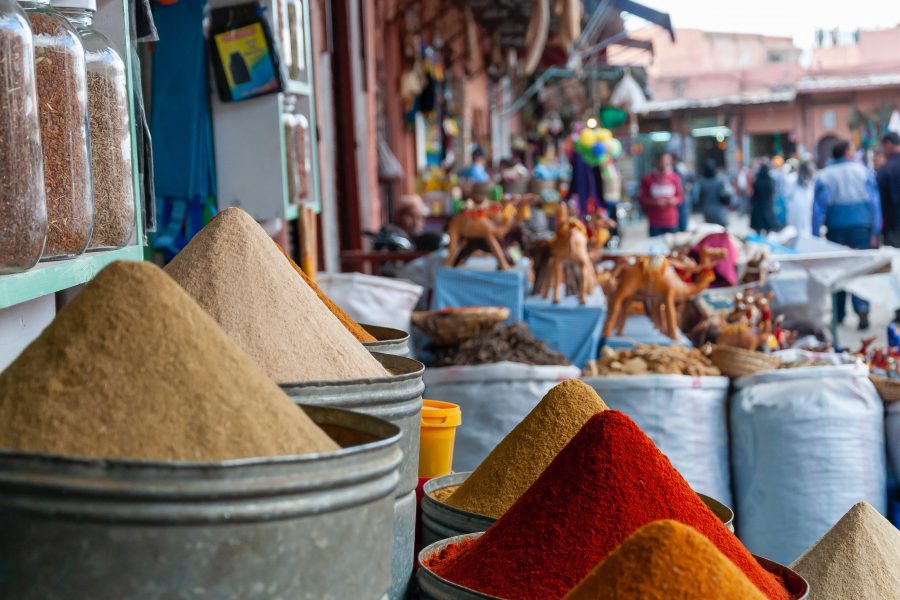
Most spices in Morocco have skyrocketed in price due to ongoing inflation that has affected several food products such as wheat, cooking oil, mineral water, and milk.
Hespress EN examined current spice prices in a large distribution supermarket and noticed that white pepper costs MAD 13/100g, cumin costs MAD 8,29/100g, black pepper costs MAD 9,60/100g, and cinnamon costs MAD 8.70/100g.
Trade and business development manager in the MENA region for a major Emirati company that exports to Morocco, Nuha El Haddad told Hespress EN that prices of imported products are now on some newfound levels. Almost shoulder to shoulder with local natural bio products.
“Black pepper is considered to be the reference for spices around the globe. Prices for black pepper at the beginning of the crop season in the origin country (mostly Brazil or Vietnam) vary between USD 3000/ton to USD4000/ton depending on the quality variation,” she specified.
“In Morocco, black pepper’s custom charges increased for the final consumer, reaching around USD8000/ton, double the price,” she stated.
“The increase in custom charges is not due to the COVID-19 pandemic alone or the ongoing Russia-Ukraine war, but it is the combination of misfortunate events and the fact that market regulations almost disregard spices as it may not be seen as a necessity yet,” the trade and business development manager further stated.
Are prices affected by this 2022 inflation?
The MENA trade manager said we cannot blame, neither solely on war, nor the health crisis, and even fuel prices.
“It is a combination of disasters that usually has collateral damage. And the weakest markets with the smallest margins usually face the hardest times. Spices for instance is the market with the smallest margin due to the intensity of importers and the accessibility of providers internationally,” El Haddad stated.
“The pandemic is not to blame entirely this time,” she said, adding that, “prices started surging a tad bit before 2020 when ONSSA applied new rules of health and sanity on food products.”
“Of course, it benefits Moroccan consumers, but it also gradually moved the market toward a price-increasing trend,” she added.
The MENA trade manager further stated that just before the waters calmed the pandemic hit during the highest season of spices: a food exhibition in Dubai, held in February 2020.
“Importers made their plans of purchasing for the next eid (Fitr) expected in June/July, little did anyone know that the world will halt completely and the cost of everything including the US dollar will surge super high and make all costs extreme and for a dying demand,” she added.
According to the trade and business development manager, the ongoing ONSSA plan o to cure and purify the consumption of food products as well as the post-pandemic regulations of almost tourism, which initially brings currency to deal with in trades, in addition to the impossibly high prices of fuels due to the ongoing war, products with insignificant existence become a major victim and entirely marginalized in terms of government plans to regulate these markets.
“The approaching of Eid Al Adha also results in the increase of the spices trade activity,” El Heddad added, noting that even plan B, the local product had faced a couple of major challenges, including drought and manpower shortage to produce it,” she concluded.
Recently, the World Bank approved a USD 500 million loan for Morocco, aimed at improving human capital, according to a recent press release published on June 16.
“The combination of the COVID-19 pandemic and a two-year drought, in addition to the Russia-Ukraine war, pushed the Moroccan Economy into a deep recession in 2020 and led to an increase in poverty,” explained the World Bank in the same press release.









add your comment
Terms of publication : Not to offend the writer, people, sacred things, or attack religions or the divine self, and refrain from racist incitement and insults.