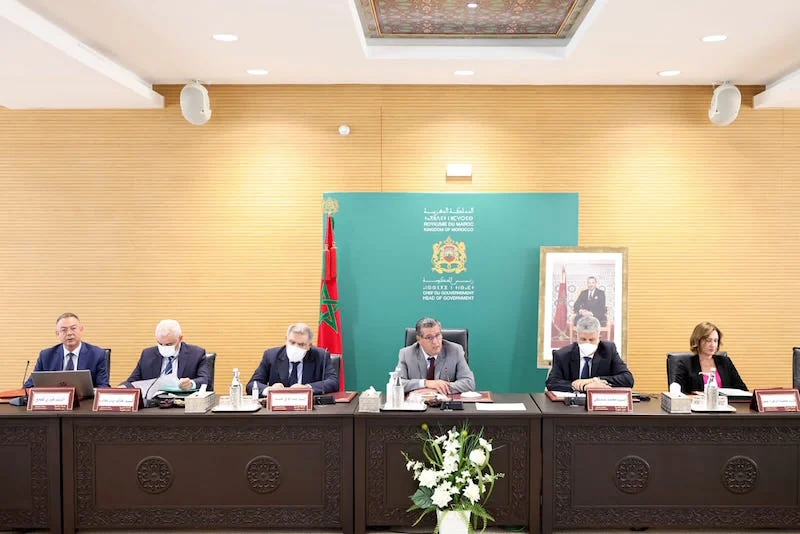
Head of the Moroccan Government Aziz Akhannouch exposed his administration’s comprehensive, ambitious health sector reform, as medical professionals question the feasibility of such “grandiose, out of touch” plans.
During a plenary session of oral questions of the House of Representatives this Monday, Akhannouch listed his Health Ministry’s goals for the sector, which touch on regional governance, human resources reinforcement, infrastructure rehabilitation, and accessibility of health services for all.
This reform project is based on the three aforementioned axes, said the head of the executive, who emphasized the imminence of this project’s application on the ground, announcing that an agreement will be signed next week between the Ministry of Higher Education and the Ministry of Health.
This agreement focused on the necessity of ensuring sufficient and well-equipped personnel, aims to increase the number of training seats in faculties of medicine and pharmacy as of the start of the 2022-2023 academic year, promising an annual increase of 20% in the number of students admitted to Moroccan med and pharmacy faculties.
Improving the public health sector’s attractiveness
Citing data during his presentation, Akhannouch said he and his administration are aiming to limit the number of medical and pharmacy students who, after graduation, venture abroad to practice.
“We do not have precise statistics, but approximately 30% to 40% of graduates of medical schools try to go abroad because of a more attractive offer, but also due to the weakness of the attractiveness of recruitment in the public sector and the unequal territorial distribution of health personnel,” he specified.
These factors are behind the decrease in the number of practicing doctors, said the head of government, adding that “this phenomenon threatens our ability to strengthen access to social protection.”
To address this problem, the official suggests a strategy to double the number of graduates from medical schools by the end of his mandate and to triple the number of graduates in nursing schools.
“This strategy will allow the government, in the medium term (2025-2026), to exceed the 23 medical and paramedical staff for every 10,000 inhabitants quota, determined by the World Health Organization (WHO) as the minimum threshold to meet the medical needs of citizens,” he continued, saying: “it will also allow reaching the objectives of the New Development Model by 2035.”
Infrastructure, a major lever to the health reform
In terms of infrastructure, the head of government promised the construction of a university hospital center (UHC) in each region, as well as the rehabilitation of 1,400 community health centers over the next 18 months.
The official added that the government is working on a project to digitize the health system, which will be set up and linked to the National Social Security Fund (CNSS), to create the digital health card.
“This will make it possible to follow the patient’s treatment from the local health center to the university hospital,” said Akhannouch, adding that this digitization project is undergoing final adjustments, and will simplify procedures and make citizens’ access to health services more fluid.
Despite the benevolence and ambition of the current government’s plan, medical students are calling out the “out of touch” approach of the reform, saying it ignores many demands they’ve expressed before.
Feasibility in question
Mohamed Kassimi Alaoui, coordinator of the National Commission of Medical Students in Morocco (CNEM) told Hespress FR that medical students have been following this issue very closely since the publication of the New Development Model, whose objective is to achieve an average of 45 medical staff per 10,000 inhabitants by 2035, largely exceeding the WHO’s minimum threshold.
“Morocco needs many more doctors. This is a reality. That said, today we have the same fears expressed regarding the integration of Moroccan students from Ukraine, which are once again posed with regard to the increase in the number of training positions,” says Mohamed.
Recently, the CNEM has addressed the network of public medicine faculty deans and the Ministry of Higher Education to explain its thoughts on the difficulty, if not the impossibility, to increase the number of training seats, without accompanying measures including the increase of training sites, namely the UHC.
“They say they want to increase the number of doctors. How do they do this? By increasing the number of faculties. They plan to build 3 public and 3 private faculties in Morocco next year. This is not as complicated as it is about buildings and walls. But what about the training grounds that will have to accompany the creation of these faculties and where students are trained, especially specialists? We have the example of Agadir and Tangier where for 7 years, a whole class has never set foot in a UHC,” says the coordinator of the CNEM.
The CNEM sees that the increase in capacity should be conditioned by concrete and serious support, through creating training grounds such as UHCs, provincial hospital centers, and regional hospital centers or by devoting a budget to the reorganization of the current establishments, so that they are able to accommodate students and residents depending on their specialty.
According to him, “we can not be satisfied with building faculties and university hospitals without increasing the number of teachers and health executives.
“We have been promised an increase the number of supervisors and professors, but in accordance with the possible ratio and standards,” which is yet another promise that has not been met.
Indeed, Mohamed Kacimi argues that it is not enough just to recruit teachers, but it is necessary to put in place mechanisms to keep them in public education as they are not valued and their salary is not sufficient.
Similarly, the same source specifies that there is no mechanism to control their performance, their availability at the level of UHC since they have the right to go work in the private sector, “where the need to provide a legislative and budgetary effort to move things forward,” he said.
“You can’t announce an increase in the number of student seats and staff without addressing all of the above. But if the government puts in place mechanisms to resolve these points, we will be the first to give a hand because it is our country. concludes the coordinator of the CNEM.






add your comment
Terms of publication : Not to offend the writer, people, sacred things, or attack religions or the divine self, and refrain from racist incitement and insults.