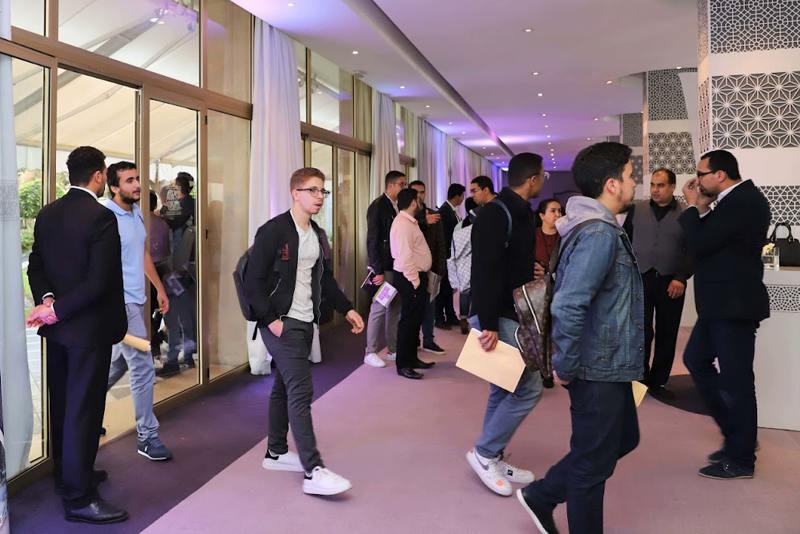
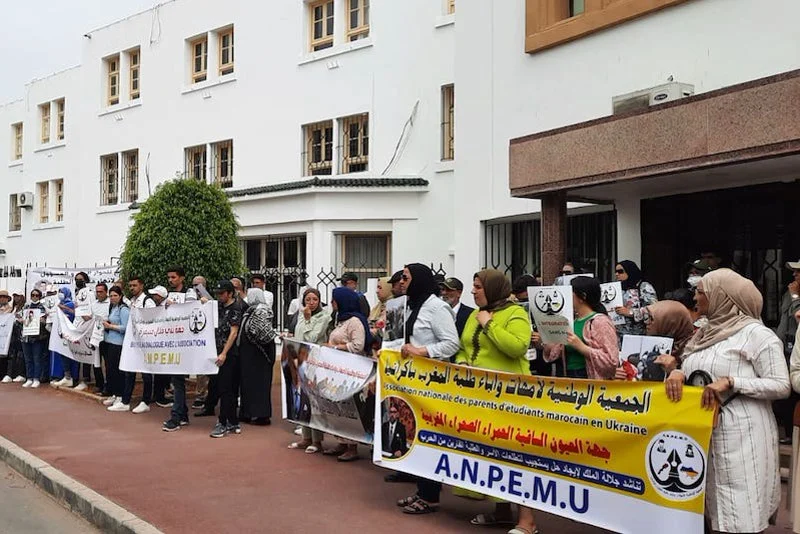
The National Commission of Students in Medicine, Dentistry, and Pharmacy has refused the integration of Ukrainian medical students into public Moroccan universities, in a statement issued on March 20, citing overcrowding and inadequate infrastructure as reasons behind the stance.
The students outlined their motivations behind the refusal, saying that “the quality of education” will deteriorate due to the system’s inability to receive more students.
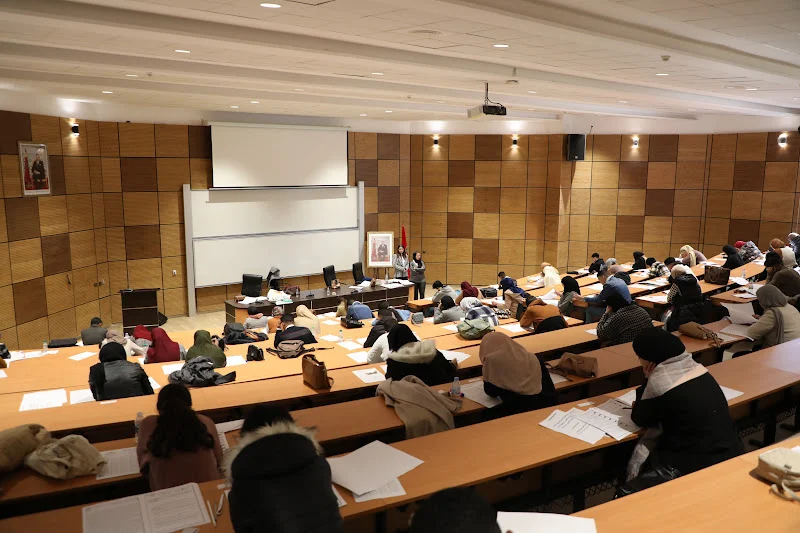
The National Commission insists on the “current overcrowding” in the faculties of medicine, dentistry, and pharmacy.
It points to the need for increased budgets, human resources, faculty members, and staff, as well as the urgency of governance reforms within hospital training.
“The difficult situation within faculties pushes to exclude any possibility” of integrating students returning from Ukraine within the Moroccan educational and medical institutions.
The commission’s statement said the group of students is open to a dialogue with competent government officials, to discuss “other solutions that do not negatively affect the quality of education in Morocco.”
Meeting with the Minister of Higher Education
Sources confirmed to Hespress EN that the commission has scheduled a meeting at the end of this March with the Minister of Higher Education Abdellatif Miraoui, to explore the possibilities available to the government, saying that the students “are willing to make compromises, but not fully succumb to pressures.”
Qasmi Alaoui, a member of the commission, told Hespress EN that “the returning students are our brothers and sisters, of course, we would love to have them join our ranks,” but that the “catastrophic and critical situation of Moroccan medicine universities and public hospitals” does not allow such generosity.
The students’ refusal is, according to Alaoui, solely motivated by “the principles of equity and merit, and the national system’s incapacity to take on more students.”
However, “the commission’s statement is not exclusively in response to the Ukrainian students’ issue,” said Alaoui, adding that “we are first and foremost demanding the government respect its word in relation to its promises dating back to 2019.”
Unfulfilled Promises
Morocco’s medicine students had protested for over five months that year,
declaring a nationwide strike and boycott of classes and exams, after the government decided it will include private sector students in public residency selections.
The government and students reached a written agreement with the executive, which Alaoui says has yet to materialize.
“Our situation as medical students in Morocco is in itself critical and in dire need of intervention,” says Alaoui, adding that the government can’t expect students to comply with a possible inclusion “unless it guarantees a significant increase in its allocated budget, the recruitment of sufficient staff, professors and all while investing massively inadequate infrastructure.”
The commission’s sentiment is widely shared among the students, who fear “a total deterioration of learning conditions and the subsequent devaluation of the Moroccan medical degree.”
Issam, a first-year student told Hespress EN that “overcrowding is already a serious concern for med students in the country,” which is why he disagrees with the integration.
According to Issam, “the quality of education and access to residency will inevitably suffer from pumping thousands of additional students to a system that is already suffering greatly.”
Some students, however, “wish to see the commission and government agree on an acceptable solution for both parties, as we would hate to see the returning students waste their efforts and academic achievements over a war.”
A silent minority
Khadija S, a third-year medical student told Hespress EN that “considering we are both in the same field, we empathize greatly with our compatriots as medical studies are highly demanding and require a lot of effort and self-discipline, and it would be devastating to see them lose all those years for nothing.”
But, “the government should present real and concrete guarantees to the med students in Morocco prior to any kind of inclusion, as a failure to invest properly will hurt everyone involved, and primarily the patients.”
The returning students are just as divided in their opinions, Rania B tells Hespress EN, adding that “some would like to stay home and resume their studies, while others are more tempted to transfer to neighboring Romania to continue their academic careers.”
Rania argued that “the Moroccan government had stated it was ready and open to receiving foreign doctors to resolve the problem of scarcity of medical staff, wouldn’t it be better to prioritize Moroccans through increasing the number of domestic students ?”
Parents, on the other hand, are almost unilaterally agreeing that “transferring to yet another European country will only increase costs and burden families.”
With one of the largest foreign student communities in Ukraine, Morocco is now facing a major challenge in its attempt to redeem the returning students, especially those in medical and engineering fields who also just so happen to constitute the majority.
The meeting between the commission and the competent government officials, scheduled for the end of this month, will likely be the first of many, as the executive and the Kingdom’s future doctors debate the fate of the repatriated youth.





add your comment
Terms of publication : Not to offend the writer, people, sacred things, or attack religions or the divine self, and refrain from racist incitement and insults.