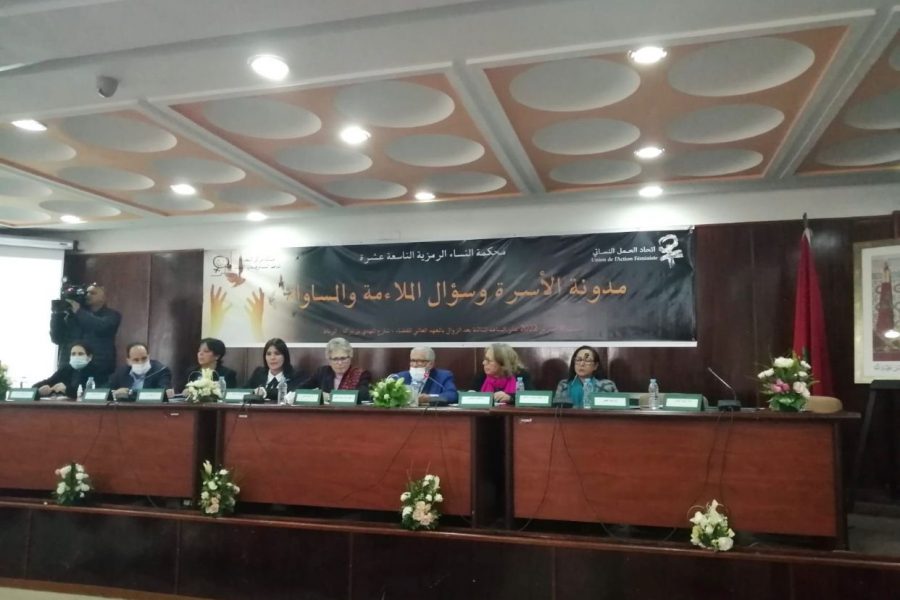
In the framework of its second national campaign for a “radical” and a “global” change of the family code and on the occasion of International Women’s Day, the Union of Feminist Action organized, yesterday 19, 2022, its 19th symbolic women’s court under the theme “Family Code and the question of harmonization and equality.”
The event, organized annually, gathered several civil society actors, including associations of women’s rights, associations of human rights, activists, and experts in numerous fields such as doctors, lawyers, political scientists, and researchers.
Some state actors also attended the event, including the Ministry of Justice representatives and others.
The symbolic tribunal aimed to identify gaps in the Family Code at the level of both the text and its implementation 18 years after its promulgation.
In the framework of the symbolic tribunal, the Union organized hearings of women with different backgrounds, social statuses, and experiences.
These women talked about their actual experiences with violence perpetrated by husbands and families, enforced by “discriminatory laws.”
Following the hearings, judges and experts formulated verdicts that contained recommendations on how and what to change at the level of laws, judicial practices, and the societal structure regarding the issues of violence and discrimination against women.
Aisha Al Hayyan, lawyer and president of the Union, stated to Hespress EN that “the symbolic tribunals have large audiences since 1996. This way of listening to live testimonies allows a strong impression”.
“The aim is to formulate a verdict or a decision that will comprise several recommendations, which will constitute a pleading material to parliamentary groups, political parties, and the government and governmental sectors concerned.
“The recommendations will not solely result of the efforts of the Union of feminist action, but all the associations and the experts,” she continued.
Recognizing that the Family Code, constituted a considerable leap in the field of Personal Status at the time of its launch, the Union of the Feminist Action considers that the Code did not completely break with “its philosophy, content, and language with the conservative patriarchal perspective on family relations and the status and rights of women within it.”
This conviction of the necessity of introducing changes into the Family Code results from fieldwork with women and girls in the twelve national support centers and shelters administered by the Union. The Union receives women victims of all forms of violence and discrimination.
Most of the violence is perpetrated by spouses within the family home, and the Union considers that the laws in force do not guarantee complete justice for these women.
The Union also produces annual reports on the forms of violence practiced against women, which result in the hearings it organizes annually in the framework of the symbolic women’s courts.
“These symbolic tribunals have previously played a central role in advancing the Personal Status Code,” stated Aisha Al Hayyan to Hespress EN.
“Sometimes at the level of the legislators or governmental sectors, when you argue as a civil society about the issues in some laws, you are considered a civil society, sometimes exaggerating or sometimes not tackling the reality as it is.”
“But when those in charge listen to the truth by women who have been subject to violence and discrimination, it impacts.” She continued.
“Sometimes those in charge of these laws, if they do not get to the ground and listen to these sufferings, it would be hard for laws and texts to meet the population’s expectations.”
“These symbolic tribunals fulfill this necessity, and many actors of national institutions, governmental sectors, and civil society were present today and were listening.” Added Aisha Al Hayyan on the importance of symbolic tribunals.
The event, attended by a large audience, raised the question regarding law texts related to relations between spouses, injustice and violence against women and girls, impoverishment and insecurity in matters of marriage, child marriage, divorce, legal guardianship of children, alimony, custody, polygamy, inheritance, and others.
The symbolic tribunal is part of the Union’s efforts of awareness, mobilization, and advocacy for women’s rights.



add your comment
Terms of publication : Not to offend the writer, people, sacred things, or attack religions or the divine self, and refrain from racist incitement and insults.