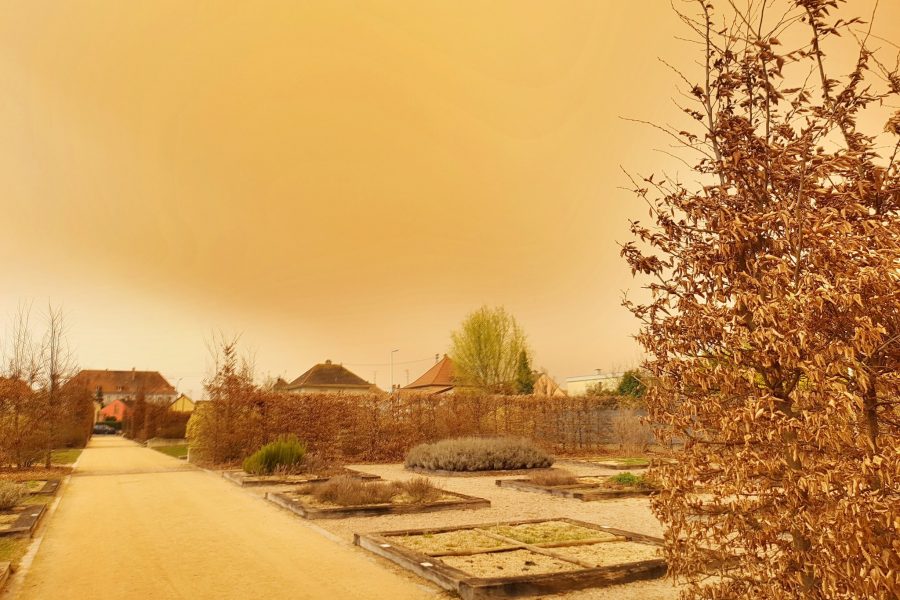
For several days, French skies have been tinged with an orange hue, as cars, buildings, and streets were covered with thin layers of dust for almost four days. In addition to the “hassle”, this natural phenomenon is causing French citizens, health repercussions are at the forefront of the people’s concerns.
The orange sky that the French can observe, which had first occurred in the Eastern-North of Morocco a few days prior, is linked to a rise of sand from the Grand African Sahara, and usually occurs when an Atlantic low tide plunges southward and is positioned on the Iberian Peninsula, raising a strong warm wind from south to southeast on the Maghreb.
Spanish, French citizens, and media are not strangers to the phenomenon, but the health worries are valid. As French authorities recommended wearing a mask when outside, especially for people with respiratory problems, the wave of sand is refreshing the painful memory of French nuclear tests carried out in the 1960s in Algeria.
Concerns over the radioactivity of the sand are amplified, experts agree that the fallout from the nuclear experiments has left a lasting mark on the Sahara Desert, as the French Institute for Radiation Protection and Nuclear Safety assured.
This fallout is the result of a hundred atmospheric tests carried out by several major powers as Algeria was under French rule, which included the USSR and the United States with 219 tests each, the United Kingdom with 23 tests, China with 22, and France with 4 in the Sahara.
According to nuclear experts, the sand contains cesium 137, a radioactive element with a half-life of 30 years, which can affect these particles.
The sites of In Ekker and Reggane still bear the scars of the multiple nuclear tests in the North Africa republic of Algeria.
During the tests, nuclear airborne, atmospheric and underground explosions were shot, for which the highly radioactive waste has a lifespan of 24,000 years. The bombs for which tests were carried out were 10 to 20 times larger than those of Hiroshima, according to the works of Patrice Bouveret, Director of the French Arms Observatory.
The two explosions in Japan had taken place around fifteen years earlier than those in Algeria, with the existence of ample memos and military works proving the devastating effects nuclear weapons may pose to the peoples’ health and environment.
On May 1, 1962, one of the tests, dubbed the Beryl underground test, did not go as planned, as some of the radioactive dust, which should have been contained in an underground tunnel carved inside a mountain, was released.
The resulting nuclear explosion caused highly radioactive lava to come out of the mountain. As early as 2007, the mass was confirmed to be still on-site and in the open air, according to a report from French outlet TV5 Monde.
Bouveret told media that “local scientists advised the French team visiting the site to not stay more than 20 minutes,” in which case they would have been exposed to “the maximum doses admissible to a person working in the nuclear industry for a year.”
In 1966, France dismantled its nuclear and military installations shortly after Algeria’s independence, the military hastily buried radioactive, contaminated planes in the sand at shallow depth.
A multitude of reports has been issued, linking the radioactive areas in the Maghreb to an accentuated rate of cancers and chronic deadly illnesses to the regions’ populations.
A simple clean-up could significantly help the residents, but France not only left its waste, but also classified all the documents that could have been related to these programs as Defence secrets, binding them to the highest levels of state security clearances.
The Sahara dust storm that arrived in Europe this March will likely not result in any significant health repercussions, as French specialists of radioactivity reassured the people that since the phenomenon had already occurred in February 2021, without major consequences on the air quality, it is unlikely to amount to anything this year.
Local populations in the Maghreb, however, are continuously suffering of toxic waste, with rising cases of cancers, respiratory ailments, and chronic diseases.









add your comment
Terms of publication : Not to offend the writer, people, sacred things, or attack religions or the divine self, and refrain from racist incitement and insults.