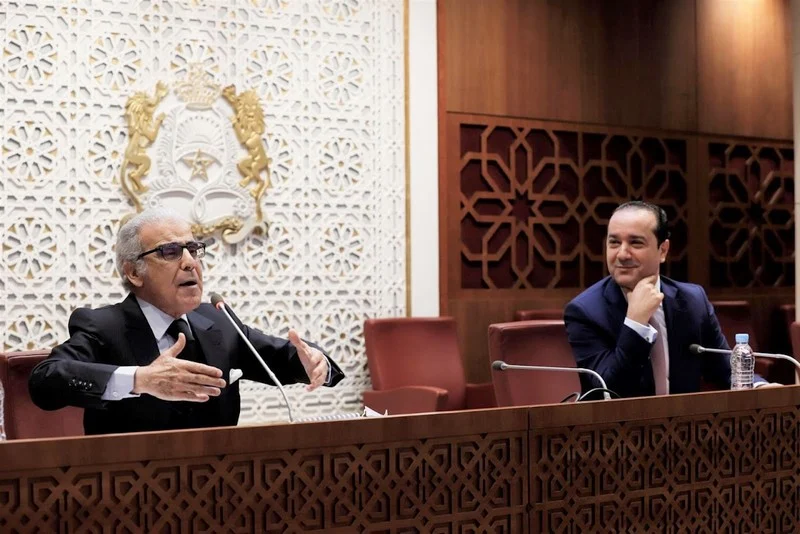
In a presentation to the Parliament’s Finance Commission, Wali of Bank Al-Maghrib (BAM) explained that “a proper assessment of private investments in Morocco is untimely due to the staggering lack of updated, consolidated data.”
President of Morocco’s central bank Abdellatif Jouahri said that “information on private investment in Morocco remains fragmentary and available but most often after a certain delay, which does not allow a timely assessment of its evolution.”
He specifies that the sources of information in the field are diverse, citing various annual surveys from the High Commissioner for Planning, the Ministry of Industry, the World Bank, the Moroccan Office of Industrial and Commercial Property, the Office of Foreign Exchange on direct foreign investments and others.
Jouahri stated that despite the rich and diversified sources, information remains disparate, which does not provide reliable information for in-depth analysis.
“Faced with this disparity of sources, on the one hand, and the difficulty of accessing information, particularly detailed information, on the other, our country now needs to set up a national business directory, following the example of what exists in advanced countries and in some emerging economies,” recommends the president.
A national private investment directory will, according to the president, “provide reliable, comprehensive and up-to-date information on the situation of our economic fabric.”
The only information that the Wali was able to communicate to the deputies relates to data on the productive fabric, its financing, and the obstacles to its development.
Starting with the fragmentation of the structure of the productive fabric, Jouahri said it is dominated by very small enterprises, and a relatively small number of larger exporting companies. The Wali noted that 92% of companies are microenterprises with an annual turnover under MAD 3 million, as 84.4% have a turnover of less than MAD 1 million.
Tax pressure is also concentrated on a very limited number of companies, namely 2% of firms paying 80% of the national company tax income.
According to data from the National Changes Office, the number of active exporting companies did not exceed 4,309 in 2019.
Per thousand inhabitants, the number of exporters in Morocco is at 0.2 per thousand inhabitants, a relatively low rate in comparison to Romania with 1.1 exporters per capita, Bosnia (1.8), Croatia (1.9), Bulgaria (3.3), Spain (3.4), Portugal (4.6), Slovakia (5.6), Estonia (10.8), and Slovenia (11) among others.
In addition to their fragmentation, Moroccan companies have “a low investment capacity,” explains Jouahri.
The head of BAM explained that “the investment capacity of small and medium companies remains low, with only 29.4% of micro-enterprises reporting investments between 2016 and 2018, compared 49.5% for small and medium companies, and 80% for large firms and companies.”
Abdellatif Jouahri additionally demonstrated to MPs at the presentation that the financing of Moroccan companies is dominated by self-financing and limited recourse to external, third party financing, dispelling the preconceived notion that Moroccan companies are in significant debt and rely heavily on financial institutions.
Jouahri referenced data from the Moroccan Observatory of the very small and small enterprises (OMTPME) for the 2019-2020 year, demonstrating that “the share of financial debt for such companies is around 20%.
In international comparison, this share remains, according to available data, lower than those recorded in countries such as France (37%), Germany (36%), Portugal (33%), Spain (30%), and Poland (22%).
This finding is corroborated by the results of a 2019 World Bank survey, which showed that investment in Morocco is financed to the tune of 8% by bank loans against 12% for lower middle-income countries and 14% for the Middle East North Africa region.
However, in the little external financing recorded, bank loans remain the main source of financing for companies and constitute 96.6% of shareholders’ liquidity for tier private investments, while recourse to the capital market remains low and largely dominated by financial institutions and the country’s largest companies.
A few days after Jouahri’s extensive report, competent government officials participated in a working session presided by King Mohammed VI, which is set to green light a number of fiscal and financial aid measures to help improve private investments in Morocco.






add your comment
Terms of publication : Not to offend the writer, people, sacred things, or attack religions or the divine self, and refrain from racist incitement and insults.