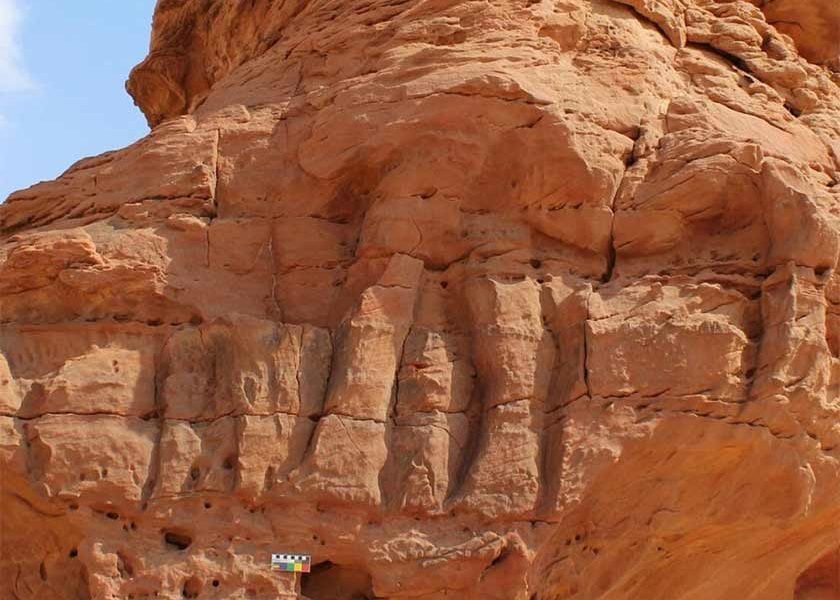
In 2018, researchers in northern Saudi Arabia discovered a series of life-size camel sculptures, estimated to date back 2,000 years, however, a recent study indicates that the estimate may have been off by 6,000 years.
The discovery, which was published in the “Journal of Archaeological Science: Reports,” suggests that the so-called “Camel Site” actually dates back 7,000 to 8,000 years ago.
It even predates the domestication of camels, a catalyst for economic development in the region.
If this timeline is accurate, the sculptures are likely to be the oldest surviving examples of large-scale, three-dimensional animal reliefs, according to reports.
In contrast, the Egyptian pyramids were constructed nearly 4,500 years ago, while Stonehenge in England was constructed about 5,000 years ago.
“They are absolutely stunning and, bearing in mind we see them now in a heavily eroded state with many panels fallen, the original site must’ve been absolutely mind-blowing,” Maria Guagnin, lead author and an archaeologist at the Max Planck Institute for the Science of Human History, explains to the National. “There were life-sized camels and equids two or three layers on top of each other.”
The original age estimate for the sculpture was determined by the existence of other camel reliefs generally attributed to the Jordanian period. However, radiocarbon dating, an analysis of weathering patterns, and other dating methods indicated that the earth’s origins were much older.
The site was also unmarked for pottery or metal tools, according to a stone mason.
“Every day the Neolithic was more likely until we realized it was absolutely a Neolithic site we were looking at,” Guagnin says to the same news outlet.
The camels represented in the reliefs have bulging necklines and round bellies, which are typical characteristics of the animals during mating season. This could mean that the site was associated with fertility or a particular time of year.
“Communities of hunters and herders tend to be very dispersed and mobile, and it’s important for them to meet at regular times during the year, to exchange information, spouses, and so on,” Guagnin says. “So whatever the symbolism of the sculptures, this may have been a place to bring the whole community together.”
Over time, the sculptures have been reengraved and reshaped, as evidenced by the weathering patterns.
“Neolithic communities repeatedly returned to the Camel Site, meaning its symbolism and function was maintained over many generations,” says Guagnin in a statement.
The sculptures may have served as a way to bring the whole community together, regardless of their symbolic meaning.
About 6000 BCE, the Arabian Peninsula was filled with grassland with much more water than it has today. Tens of thousands of square miles in the region are covered with stone monuments called mustatils.
Guagnin remains unclear whether the same people created the Camel Site and the mustatils.
Additionally, the purpose of the creation of the camel sculptures is unclear, but the researchers have suggested that it could have been created for the purpose of setting a meeting point for nomadic tribes.
In the area, there have been other two-dimensional engravings, but nothing to compare with those found at Camel Site.
With erosion continuing to degrade the sculptures, the researchers say it’s important to learn as much about them as possible.
“Preservation of this site is now key, as is future research in the region to identify if other such sites may have existed,” says Guagnin in the statement.










add your comment
Terms of publication : Not to offend the writer, people, sacred things, or attack religions or the divine self, and refrain from racist incitement and insults.