As the world turns the corner on the COVID-19 pandemic, the International Monetary Fund is projecting a stronger global recovery than it did in January, but says that policymakers must address an economic recovery across countries and regions that is “asynchronous and divergent,” marked by a widening gap between rich and poor and increased financing needs limited by constrained budgets.
A tumultuous 2020 saw one of the most significant global economic downturns in history due to the coronavirus pandemic. Despite the stock market seeing record highs now, many US economic indicators remain depressed compared to pre-pandemic levels. Applications for state unemployment benefits are still more than three times the levels seen before the health crisis, according to the latest data, and the number of airline passengers—while improving—also remains down.
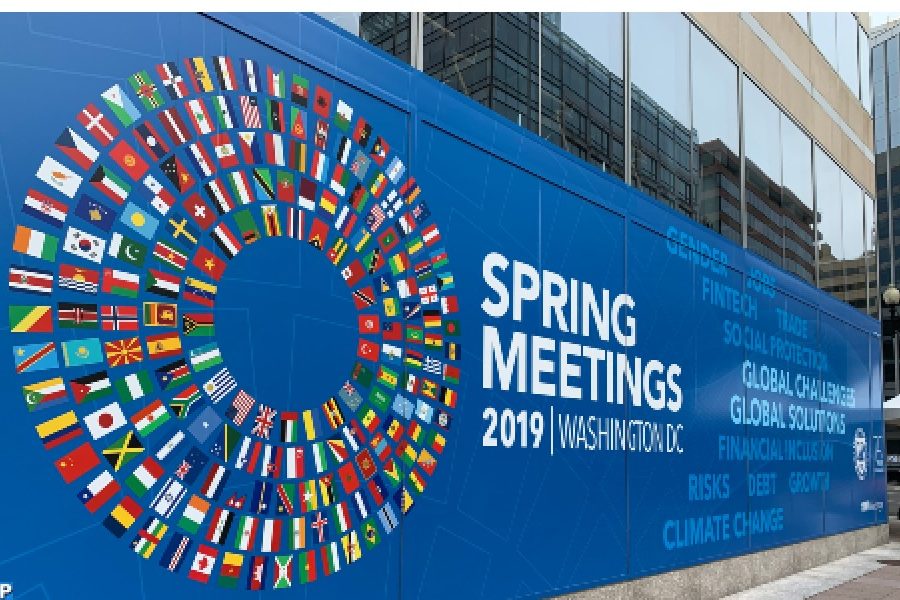
Nevertheless, the global economy is thought to be emerging from the worst phases of the COVID-19 pandemic, according to the International Monetary Fund (IMF) which is holding its annual spring meeting virtually this week in Washington, DC, from Monday, April 5, through Sunday, April 11. However, the IMF says the prospects for economic recovery diverge starkly across the various regions and countries of the world creating challenges for policymakers.
The economic trauma could have been much worse though, according to the organization, had the global economy not been supported by both “unprecedented policy actions” taken by central banks and prudent fiscal measures implemented by governments. Yet, the IMF has some lingering concerns.
Since August 2020, US long-term interest rates have been rising, spurred on by improving vaccination prospects and strengthening growth and inflation. The yield on the US 10-year Treasury note has risen by 1.25 percentage points to around 1.75% in early April 2021, returning close to its pre-pandemic level of early 2020. While both nominal and real interest rates have risen, according to the IMF’s latest Global Financial Stability Report, nominal yields have risen more, suggesting that market-implied inflation (the difference between yields on nominal and inflation-indexed Treasury securities) is recovering.
To be sure, a modest amount of inflation has been an intended objective of monetary policy. But the increase may also reflect not only uncertainty about future monetary policy but also investor concerns about the increased supply of US Treasury debt available to finance fiscal expansion in the United States.
The rapid and persistent rise in US rates this year has been accompanied by an increase in volatility.
Although global rates remain low by historical standards, the fast rate of adjustment in US rates can precipitate volatility in the global financial markets. Any abrupt and unexpected increase in US rates may mean a tightening of financial conditions, particularly as investors seek to reduce their risk exposure and protect their capital.
Overall global financial conditions have so far stayed easy, according to IMF. The IMF’s chief economist Gita Gopinath says a way out of the health and economic crisis is vaccinations. They are likely to power recoveries in many countries in 2021.
Countries with slower vaccine rollouts, more limited support from economic policy, and those more reliant on tourism are likely to do less well. Such countries may not yet be ready for tighter financial conditions. Policymakers may be forced to use monetary and exchange-rate policies to offset potential tightening.
In the US, President Biden signed into law the American Rescue Plan in March, the largest recovery plan in US history. It contains a $1.9 trillion fiscal stimulus package containing direct checks for millions of Americans and it extends unemployment benefits for millions more. The plan will give a powerful jolt to the US economy.
The IMF outlook for the US economy is an optimistic 6.4% growth rate for 2021. While the 2021 outlook for China eclipses that at 8.4%, the US is nevertheless expected to be driving the global recovery due to the impact of the US economy.
Gopinath said that “the two biggest factors” driving the IMF’s stronger forecast for global recovery are the impact of the stimulus package (representing “a big chunk”) and adaptation.
“If you look around the world,” she said, “countries continue to adapt to living with the pandemic so even though the virus cases are high, the effect on economic activity has not been as bad as one might have anticipated.”
So where do fiscal decision makers go from here? To prevent excess volatility in financial markets, the IMF says that major central banks will need to communicate their policies clearly. In addition, emerging markets when implementing monetary and fiscal strategies may need to adopt mitigation measures to avoid excessive tightening of domestic financial conditions, while at the same time considering policy interactions and their own economic and financial conditions.







add your comment
Terms of publication : Not to offend the writer, people, sacred things, or attack religions or the divine self, and refrain from racist incitement and insults.