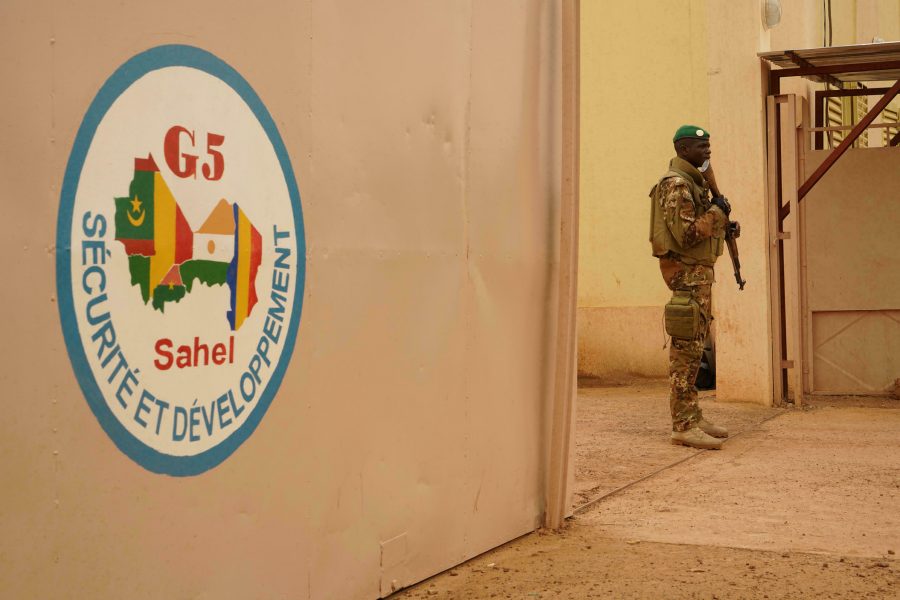
The foreign ministry of Mali summoned France’s ambassador to Bamako, Mali’s capital, on Tuesday, over comments by President Emmanuel Macron that it said were unfriendly and disagreeable.
This is the newest episode of an intense dispute between the African country and its key military partner, the French Republic.
Mali’s prime minister has accused France of “abandoning” Mali in the joint fight against Islamist insurgents, referring to French president’s decision to end Operation Barkhane in Mali.
At the July G5 Sahel summit, The French president, Emmanuel Macron announced the end of operation Barkhane, a major military operation involving roughly five thousand troops that it has led in Mali since 2013.
He further explained that France’s military footprint would be reduced by half by early 2022 to approximately 2,500-3,000 soldiers.
Some bases in northern Mali will close, but French forces will continue to target the leadership of groups affiliated with the Islamic State (ISIS) and al-Qaida and accompany local armies, notably through the Task Force Takuba (made of European special forces), which will be moved from Mali to Niger, according to Macron’s statement.
Macron rejected the Malian official’s accuses of “abandoning Mali”, questioning the legitimacy of the Malian authorities overseeing a transition to elections after two coups in just over a year.
In August 2020, Mali’s President Ibrahim Boubacar Keïta was removed from power by a military alliance and replaced by President Bah N’daw. After nine months of political chaos the Malian Army led by Vice President Assimi Goïta overthrew Mali’s new leader, Bah N’daw. The coup that took place in May 2021 is the fifth coup since Mali’s independence in 1960.
A history of political instability baptized terrorism in Mali
After gaining independence from France in 1960, Mali endured decades of political instability.
Tuareg and Arab groups in the sparsely populated north rebelled against the government in 1963, 1990, and 2006, attempting to gain autonomy for the region of Azawad. Numerous groups, including Islamist militant groups, have taken advantage of the government’s inability to assert control over territory in the north by continuously attacking Malian government and international security forces and threatening to destabilize neighboring countries, according to global conflict tracker.
The current crisis in Mali began in early 2012 when the National Movement for the Liberation of Azawad (MNLA), a Tuareg separatist group in the north, rebelled against the regime.
The MNLA was backed by a collection of Islamist militant groups, Ansar Dine, al-Qaeda in the Islamic Maghreb (AQIM), and the Movement for Unity and Jihad in West Africa, and together the groups moved to take over territory in the north.
In March 2012, then-President Amadou Toumani Toure was deposed in a military coup carried out by the Malian army. By April 2012, the groups controlled nearly all of the territory in the north and declared independence.
The alliance between the MNLA and the Islamist groups ended in June 2012, as the MNLA broke with Ansar Dine and AQIM over the Islamists push to impose Sharia law in the north.
Islamists gained control over Timbuktu and Gao, destroying shrines and imposing a harsh interpretation of Islamic rule and began pushing toward the center of the country in 2013.
At this period, the French military started, following the request of the Malian government, deploying ground troops and launching an air campaign to push back the militants.
Through Operation Barkhane, which Macron ended recently, France continued to lead the fight in Mali and three thousand troops have been deployed since July 2014 “to protect civilians and aid the efforts of local militaries,” according to Global conflict tracker.
The UN Multidimensional Integrated Stabilization Mission in Mali (MINUSMA) was also created to combat extremism in the region in April 2013. More than thirteen thousand UN peacekeepers remain deployed in Mali and MINUSMA has been called the UN’s most dangerous mission due to the high number of attacks on peacekeepers.
Despite increased international involvement, the campaign against militants has instead resulted in the spread of militancy to countries across the Sahel.
In February 2017, France and the Group of Five for the Sahel (G5) countries—Burkina Faso, Chad, Mali, Mauritania, and Niger—announced the creation of the G5 Sahel Force, a five thousand-troop-strong counterterrorism force aimed at fighting extremsit groups with an expanded plan to move across borders in the Sahel region.
France announced in September 2021, the assassination of Adnan Abu Walid al-Sahrawi], the leader of ISIL (ISIS)-affiliated Islamic State in Greater Sahara (ISGS) group, known for its deadly attacks in Sahel, the so-called tri-border region of Mali, Niger and Burkina Faso.
“[Adnan Abu Walid al-Sahrawi], leader of the terrorist group Islamic State in the Greater Sahara was neutralised by French forces,” French President Emmanuel Macron announced in a Tweet in Septemeber.
Adnan Abu Walid al-Sahrawi, A former member of Western Sahara’s Polisario Front independence movement, al-Sahrawi joined al-Qaeda in the Islamic Maghreb (AQIM) and had also co-led the Movement for Oneness and Jihad in West Africa or Mujao, a Malian armed group responsible for kidnapping Spanish aid workers in Algeria and a group of Algerian diplomats in Mali in 2012.
The U.S. military has had offered, in the past, a $5m reward for information on the whereabouts of al-Sahrawi, who was wanted over an October 4, 2017 attack in Niger that killed four US Special Forces and four Niger troops.
Between fighting terrorism and controlling Mali: the raising French-Russian conflict of power
Reuters reported in September that the Malian junta and Wagner, a militia with close ties to the Russian President Vladimir Putin, are nearing a deal that would send mercenaries to train Malian troops and provide security for high-ranking officials.
A spokesperson for the Malian defence ministry did not deny the discussions, “Mali intends to diversify its relationships in the medium term to ensure the security of the country,” the spokesperson told AFP. “We haven’t signed anything with Wagner, but we are talking with everyone.”
Apparently, France is less than happy with the situation, the presence of Russian paramilitaries in the country is “absolutely irreconcilable” with that of French troops, said France’s foreign minister Jean-Yves Le Drian, reacting on September 15 to the news of the possible agreement between Mali and the Russian private security firm Wagner.
In recent years, Russian paramilitaries, “security instructors”, companies and advisors have grown increasingly influential in the war-torn Central African Republic (CAR), whose relations with France have also nosedived.
Forces from Wagner are also reported to be present in various countries elsewhere in Africa, including in Libya in support of renegade military commander Khalifa Haftar, in Sudan and in Mozambique.
As relations with France have worsened, Mali’s military government has increased contacts with Russia, including Defence Minister Sadio Camara visiting Moscow and overseeing tank exercises on September 4.
A senior Malian defense ministry source told Reuters earlier this week that the visit was in “the framework of cooperation and military assistance” and gave no further details, according to Al Jazzera.
French President Emmanuel Macron commented on the matter by Russia is no longer an “enemy”, and the priority is fighting against international terrorism.
However, until now, the involvement of Russian mercenaries is a red line for France’s foreign ministry. “Wagner is a militia that has shown itself in the past in Syria and Central African Republic to have carried out abuses and all sorts of violations that do not lead to any solution,” said Jean-Yves Le Drian, French Foreign minister, according to French media.
Russia has responded to “the diplomatic furore” by keeping things blurry, “there is no representative from the Russian armed forces there, and no official negotiation currently under way,” Dmitri Peskov, a spokesperson for President Putin, told journalists on September 16.
Since the Russian-Malian deal’s rumors, France launched a diplomatic offensive dispute with Malian authorities and has softened its position towards the Russian deal.
“Our priority is to be able to continue the fight against terrorism and we hope that the conditions in which we began the campaign won’t be different in the future,” the French Minister of Defence Florence Parly said, according to French media.


add your comment
Terms of publication : Not to offend the writer, people, sacred things, or attack religions or the divine self, and refrain from racist incitement and insults.