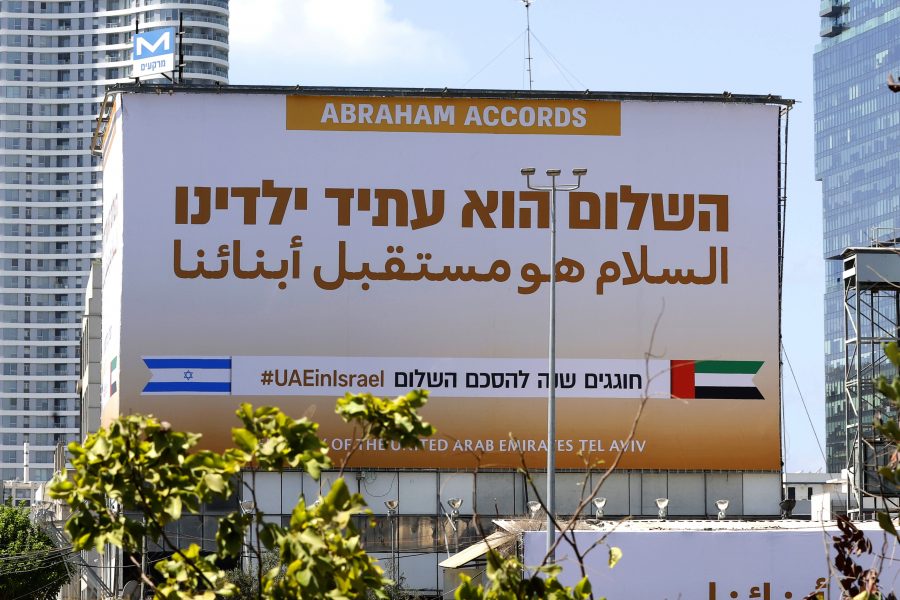
Despite the several regional conflicts in the MENA region, Palestine represented be one of the few issues that united the Arab nations on one opinion: the importance of the Palestinian cause and the boycott of Israel. It was a redline that no country dared to cross fearing the Arabic public opinion and the reaction of its neighbors in the region.
Then in 1979, Egypt became the first country in the region to cross the line and to sign a peace deal with Israel. In 2020, UAE repeated history and break the Arabic public boycott of Israel since the last agreements between Israel and Jordan in the late 90s.
From Camp David to Abraham accords, normalizing ties with Israel in the MENA has been always a sensitive political decision related to morals, religion and the Arabic responsibility towards the Palestinians under the occupation.
Egypt
On October 6, 1973, Israel was caught off guard by Egyptian forces crossing the Suez Canal and by Syrian forces crossing into the Golan Heights. The sporadic fighting, where the Egyptian and Syrian armies showed greater fighting ability than in the previous wars, ended by a disengagement agreement between Israel and Egypt, signed on January 18, 1974, provided for Israeli withdrawal into the Sinai west of the Mitla and Gidi passes, while Egypt was to reduce the size of its forces on the east bank of the canal.
On March 26, 1979, Israel and Egypt signed a peace treaty formally ending the state of war that existed between the two countries for 30 years. Under the terms of the treaty, which had resulted from the Camp David Accords signed in 1978, Israel returned the entire Sinai Peninsula to Egypt, and, in return, Egypt recognized Israel’s right to exist. The two countries subsequently established normal diplomatic relations.
The Arab League suspended Egypt’s membership and moved its headquarters from Cairo to Tunisia in protest of the Egyptian move. The Egyptian Foreign Minister, back then, Mohamed Ibrahim Kamel resigned over his opposition to the agreement, calling it the massacre of concessions.
The diplomatic relations between Israel and Egypt witnessed many conflicts and disagreements after signing the peace treaty, as in 2002, when the Egyptian government decided to stop all contacts with its Israeli counterpart in light of the Israeli forces’ invasion of Palestinian cities.
The roughest era for Israel-Egypt’s diplomatic ties was in 2012, when Mohamed Morsi, ruled Egypt with a government controlled by an Islamist majority after the January 25 revolution that ended up the 30 years regime of Hosni Mubarak.
Today, after more than four decades of normalizing ties with Israel, Egypt has established a friendly relation with its neighbor, Israel, under the rule of Abdel Fattah al-Sissi as the two countries signed a 15 million dollars deal over a natural gas project last year, and the current Israeli prime minister Naftali Bennet, paid visit to Sissi, earlier this month, to discuss the future economic and diplomatic plans between the two states, in the first Israeli Prime minister visit to Egypt in 10 years.
Palestine Liberation Organization (PLO): Oslo accords
The Oslo agreement, which was signed in Washington, DC, on September 13, 1993, resulted in the establishment of self-rule for the Palestinians, as the PLO agreed to formally recognize the state of Israel, Israel, in return, allowed the Palestinians some form of limited self-governance in Gaza and the West Bank.
The agreement, which came as the culmination of understandings that took place after 14 rounds of secret bilateral negotiations between the two parties in the Norwegian city, constituted a fundamental shift in the political track of the Palestinian cause.
The agreement was condemned by many Palestinians intellectuals and politicians as Edward Said and Mahmoud Darwish who see the accords as surrender after years of resistance, calling it an agreement of “peace without land,” while Aarafat defend it as a first step to establish the Palestinian state and end the long-lasting conflict.
The second Intifada in 2000, when Sharon, who was prime minister, visited Al Aqssa which was considered a provocation by the Palestinians, dashed any hopes of lasting peace, especially after Hamas gained control over Gaza strip in 2007 and the PLO popular leader, Aarafat, died in suspicious circumstances in 2004.
Although some provisions of the Oslo Accords remain in effect—namely, the role of the Palestinian Authority in governance of the West Bank—many of the provisions have long been abandoned.
Jordan
After negotiations with U.S and Israel during the Madrid conference under the slogan, “land for peace”, Jordan became the third in the region, after Egypt and PLO, to recognize Israel and sign a peace treaty in 1994. The deal in part centered on economic and trade incentives for Jordan vis-a-vis Israel and the United States.
The Wadi Araba Treaty adjusted land and water disputes, and provided for broad cooperation in tourism and trade between the two states.
Following the agreements, Israel and Jordan opened their borders. Several border-crossings were erected, allowing tourists, businessmen and workers to travel between the two countries as Israeli tourists started visiting Jordan.
In 1996 the two countries signed a trade treaty. As part of the agreement, Israel assisted in establishing a modern medical center in Amman.
Tensions between Jerusalem and Amman are almost as old as the peace agreement itself, after Netanyahu had replaced Yitzhak Rabin as prime minister, in 1996, the new right wing government, headed by Benyamin Netanyahu, started an aggressive policy on the issues of settlements and Jerusalem that wasn’t appreciate it by the Jordanian kingdom especially that Al-Aqsa Mosque is supervised by the Jerusalem Endowments Department of the Jordanian Ministry of Awqaf, according to international law, as Jordan is the last local authority supervising the city’s sanctities.
After almost 30 years of the Wadi Aaraba treaty, the Jerusalem-Amman relations is still living under an icy climate dues to several reasons as the decision by the US to move its embassy to Jerusalem and Israel’s subsequent campaign to get other countries to follow suit, and, more recently, Netanyahu’s vow to annex the Jordan Valley and other settlements in the West Bank.
On 22 November 2019, King Abdullah described Jordan’s relations with Israel as being “at an all-time low”, mostly because of domestic political issues in Israel.
In the meantime, relations, cold as they may be, continue to function. As in 2021, Jordan and Israel reached an agreement under which the latter would supply the kingdom with 50 million cubic meters of purchased water, on the sidelines of Jordanian Foreign Minister Ayman Safadi’s meeting with his Israeli counterpart Yair Lapid.
Public sentiments in support of Palestinian rights and against Israel and the occupation remain high in Jordan.
UAE
UAE, was the first country in the MENA region to restart the era of publicly normalizing ties with Israel in 2020 by signing an agreement deal with Israel and U.S, which was the first agreement under the Abraham accords.
Unlike the previous countries in the list, UAE has never been in a war with Israel since they are not sharing any borders, but Anouar Gragash, the Emirati Minister of State for Foreign Affairs, said, after the agreement in a television interview, that his country signed the accord “to deal with the threats facing the two-state solution, specifically annexation of the Palestinian territories,” as he urged the Palestinians and Israelis to return to the negotiating table.
Before the Abraham accords, UAE had some “shy public interactions” with Israel. In November 2015, Israel announced that it would open a diplomatic office in the UAE, the first time in more than a decade that Israel had an official presence in the Persian Gulf. In August 2019, Israel’s foreign minister made a public announcement about military cooperation with the United Arab Emirates amid rising tensions with Iran.
Since the signing of Abraham accords last year, the UAE and Israel have concluded a number of trade agreements with a notable increase in the number of Israeli startups working in the field of artificial intelligence, financial technology and agriculture has increased in the Gulf country.
In addition, the United States agreed last year to sell more than $23 billion worth of F-35 combat aircraft and drones to the UAE after its diplomatic recognition of Israel.
Bahrain
Bahrain joined, after few days of UAE’s move, the Abraham agreement, and signed the accord with Israel in the same day as Emirates did, in September 15, 2020 in the white house.
The Palestinian Foreign Ministry summoned its ambassador to Bahrain after the agreement was announced, and a statement by the Palestinian leadership spoke of “the great damage it causes to the inalienable national rights of the Palestinian people, and to joint Arab action.”
The first official Israeli delegation visited Bahrain in late September 1994. Israeli Environment Minister Yossi Sarid participated in regional discussions on environmental issues and met with the Bahraini Foreign Minister. The relations between the two states froze since the second Intifada.
In 2018, Bahrain diplomat Khalid bin Hamad Al Khalifa tweeted that the state of Israel has a right to defend itself against the Islamic Republic of Iran, which was pictured by the Israeli media as an official acknowledgement of the existence of Israel by Bahrain.
In 2019, during the workshop of “Peace to Encourage Investment in the Palestinian Territories,” organized by Bahraini state, US President Donald Trump’s son-in-law and senior adviser, Jared Kushner, presented an economic plan, which he said would offer the Palestinians a “more prosperous future” if they agreed to a peace agreement with Israel.
In September 2021, Israel appointed its first ambassador to Bahrain, after the normalization of relations with the kingdom last year, according to the Arabic-language account of the Israeli government on Twitter.
Sudan
Weeks from similar moves by UAE and Bahrain, Sudan normalized relations with Israel.
At the same time, US President Donald Trump has removed Sudan from the US list of state sponsors of terrorism, unblocking economic aid and investment.
Sudan went to war with Israel in the 1948 Arab–Israeli War and the Six-Day War in 1967, though it did not participate in the Suez Crisis.
Until April 20, 2021, Sudan had a law since 1958 that forbid establishing relations with Israel, and outlawed business with citizens of Israel as well as business relationships with Israeli companies or companies with Israeli interests.
However, in 2016, Sudanese Foreign Minister Ibrahim Ghandour floated normalized ties with Israel provided the U.S. government lifted economic sanctions. Sudanese President Omar al-Bashir followed that up by saying in an interview with Saudi newspaper Okaz.
After the revolution in Sudan, In February 2020, Israeli Prime Minister Benjamin Netanyahu and the Chairman of the Sovereignty Council of Sudan, Abdel Fattah al-Burhan, met in Uganda, where they agreed to normalize the ties between the two countries. Later that month, Israeli planes were allowed to fly over Sudan.
After further talks with Israel in October last year, Sudan agreed to normalize ties with Israel in the same month.
Sudan was notably absent from Friday’s commemoration of Abraham accords. Sudan, whose new civilian-backed government, desperate for US support, promised the former American president Trump to move forward with Israel but has since been hesitant in the face of public opposition. Blinken said that the United States would encourage Sudan to foster ties with Israel.
Morocco
In December 10, 2021, the American president, at the time, Donald Trump, announced in Twitter, before few days of the end of his administration and of him getting suspending permanently from Twitter, the Moroccan normalization of ties with Israel and the American recognition of Moroccan sovereignty over the Western Sahara territory.
The recognition was followed by a signing ceremony in Rabat with the presence of several Israeli and Moroccan officials, as well as Trump’s senior adviser Jared Kushner. The Moroccan head of government, at the time, Saad Eddin El Othmani signed the deal with Israel amid his party’s condemnation of the accords.
The agreement was followed by launching direct flights between the two countries, and an official Israeli visit to Rabat by the Israeli Foreign minister Yair Lapid where he signed three cooperation agreements on political consultation, air services and culture with his Moroccan counterpart Naseer Bourita as well as opening an Israeli Liaison office in the Moroccan capital.
Bourita started his speech in the first anniversary meeting of Abraham accords by recalling the history of Morocco’s relations with Israel that preceded the Abraham Accords by few decades.
The first Israeli official visit to Morocco was in 1986, when King Hassan II hosted the Israeli Prime Minister Shimon Peres in Rabat.
Israel had an Liasion office in Rabat, decades before the Abraham accords, but it was closed in 2000 in protest of the Israeli violence policy during the second Intifada.
Since then, however, the informal ties have continued as an estimated 50,000 Israelis travel to Morocco each year on trips to learn about the Jewish community and retrace their family histories, according to Al Jazeera.
During the Abraham’s anniversary meeting, Bourita stressed that “Morocco believes there is no other alternative to a two-state-solution with an independent Palestinian state within the borders of June 67.”




add your comment
Terms of publication : Not to offend the writer, people, sacred things, or attack religions or the divine self, and refrain from racist incitement and insults.