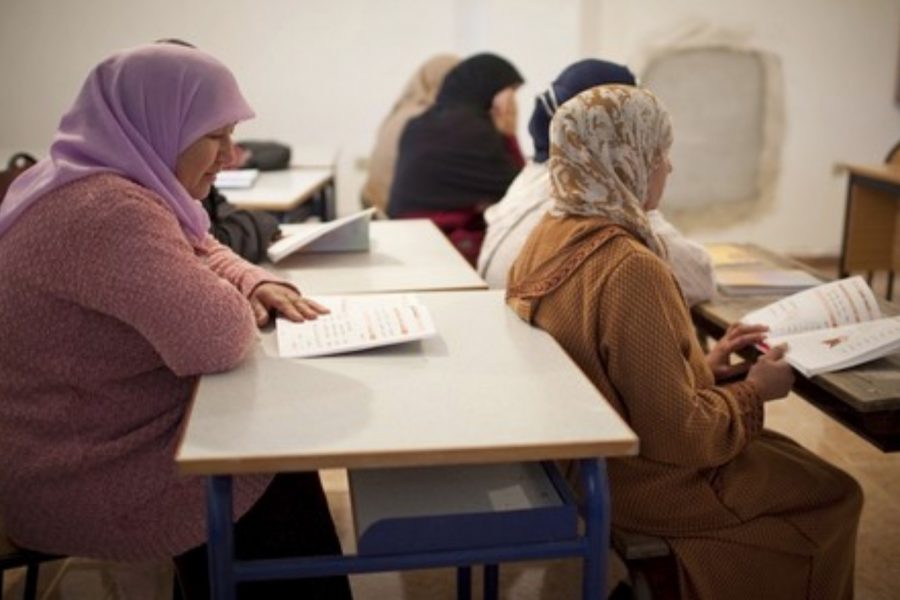
Sitting in a classroom, surrounded by her classmates, an old woman burst out in tears, staring at the Quran between her hands, unable to decode the tiny letters of the holy verses, she looked up with her watery eyes at teacher Abdellah and said: “I beg you, teacher, don’t abandon us, don’t leave us alone.”
Teacher Abdellah Belhadi, president of Rahma NGO, told the story with anguish in his voice.
“I consoled her as I promised her that one day she will be able to read easily and till that day comes we will always be there for her and her classmates,” he told Hespress Eng.
Abdellah Belhadi, a former teacher and education counselor, started his battle against illiteracy in the mid-nineties. Armed with his experience in teaching and inspired by stories of numerous Moroccan women who were deprived of the right to education, Belhadi toured the regions of Marrakech, teaching illiterate people, mostly women, about Quran, math, law and climate change.
According to a report by the National Agency for the Fight Against Illiteracy (ANLCA), in 2021, approximately 7 million men and women suffer from illiteracy on the Moroccan territory. According to the results of the 2014 Population and Housing Census, the illiteracy rate among women is 42.1%, compared to 22.2% among men.
“I started the journey of associative work first in 1996, in Demnat. In 1998, I moved to Mhamide (a region in Marrakech), it was there where we started Rahma organization’s program to fight illiteracy,” Belhadi stated.
The Rahma organization first launched a free kindergarten program dedicated to the children of the region. Shocked by the number of uneducated mothers in Mhamid, they decided to extend the program to the mothers too.
“We decided to provide education for the mothers too. Back then, there was no official program by the government, but we tried to offer the mothers an educational program that meets their needs as providing information about chronic diseases, family law and religion.”
Nowadays, the National Agency for the Fight Against Illiteracy (ANLCA) presents a detailed program with numerous curriculums that differ depending on the age and the job of the student.
Literacy rates have made strides throughout the years in Morocco, increasing with the implementation of literacy programs by NGOs and with a new 2024 goal to eradicate illiteracy.
“Today, things are better. There are programs for youth, for artisans, also there are now primary programs for beginners and advanced ones for people who want to develop and revive their knowledge.” Belhadi stated.
Rahma hosts every year, approximately, 480 students divided into 16 classes. Last year, due to the pandemic, the organization wasn’t able to offer lessons to students. They tried to provide online lessons but it wasn’t a successful experience due to digital odds, according to Belhadi’s statement to Hespress English.
The path of fighting illiteracy is not free of hurdles; the lack of professional training, the low wages offered to the programs’ teachers and the refusal of many schools principlals to let their schools open for the program’s students are all odds that make the battle against illiteracy harder.
After 25 years on this tough road, Mr. Belhadi still finds in fighting illiteracy his “joie de vivre.”
During the interview, Mr. Belhadi didn’t mention any male students while praising the determination of the female ones. He explained later, ‘I don’t really have a concrete explanation of the lack of men in the fighting illiteracy classes. During my career, I had just one class of male students in 1996.”
Figures indicate that women hold the largest number of seats to combat illiteracy, at an estimated rate of 80%, while literacy and non-formal education programs (non-compulsory education) include rural areas with an estimated rate of 49%. During the period from 2004 to 2014, the illiteracy rate among women decreased by 12.6%, while it decreased among men only by 8.6%, according to ANLCA website.
He continued, “I noticed that the determination and the power of listening that women have, we cannot find it among men, perhaps that’s the reason.”
Determination, diligence and devotion are indeed the reasons behind Zainab Boussaid’s aspiring story. When she was a child, Zainab went to school with her peers, but letters and numbers didn’t appeal to her back then, instead, her heart and mind were haunted by the love of embroidery and knitting.
“I was careless about education back then. However, I learned embroidery and knitting perfectly,” she continued referring to a Moroccan proverb, “as they say you cannot learn two things at the same time.” Zainab told Hespress Eng.
After her marriage, she moved to her husband’s family home, where she found every family member perfectly educated. Her new situation ignited a love of education in her heart. She started educating herself, trying to remove dust from the lessons that she learned when she was a child. Her family encouraged her and helped her to pursue her learning journey.
“I started studying first at home. One day, in 2004, my neighbor, who was a student in the fighting illiteracy program, introduced me to the initiative and asked me to join.” Zainab said.
The next day, Zainab joined the intermediate program and started her life-changing journey. A journey of 17 years of learning, when she managed to memorize 19 Hizb of Quran, get her elementary education certificate and convince plenty of her friends and neighbors to join the program and taste “the sweetness of knowledge”.
«Everyone started saying, don’t bother to go visit Zainab, you will find her busy,” she said laughing, “I took it with seriousness and hard work. I always went on time, holding dear my notebook of perfectly done homework,” she added with pride.
Today, Zainab, a 55-year-old mother of four, started giving lessons to new students in the illiteracy classes, encouraging them to follow her path and embrace the light of knowledge.
“I really hope more people join the classes and let pride aside. I know the main reason for not joining the classes is pride. I have been there myself, but there’s no pride in learning, it’s not shameful to be illiterate but it’s shameful to refuse to learn when you have the opportunity,” She added in perfect classic Arabic, “as they say, two don’t learn the proud one and the shy one.”


add your comment
Terms of publication : Not to offend the writer, people, sacred things, or attack religions or the divine self, and refrain from racist incitement and insults.