Every 9-year-old girl in the United States in the 1980’s knew the secrets to being a beautiful woman someday: Hälsa Highlights Chamomile shampoo for the hair, and Oil of Olay for the skin.
More than thirty years later, the fads have changed, but women are not much more immune. Argan oil, marketed for its “transformational power,” started to appear in products at spas and hair salons in the 1990’s, and slowly reached drugstore ubiquity by 2010.
Ali Hall, owner of Lock Salon in Richmond, Virginia, describes it as a “very lightweight oil that provides a lot of nourishment without weighing hair down.” International cosmetics brand Redken sells an “All Soft Argan 6 Hair Oil” as a treatment for dry, brittle hair. The labels of entire shelves of products at drugstores in the U.S. and Europe tout argan oil as the natural secret at the heart of their shampoos, deep conditioners, and more.
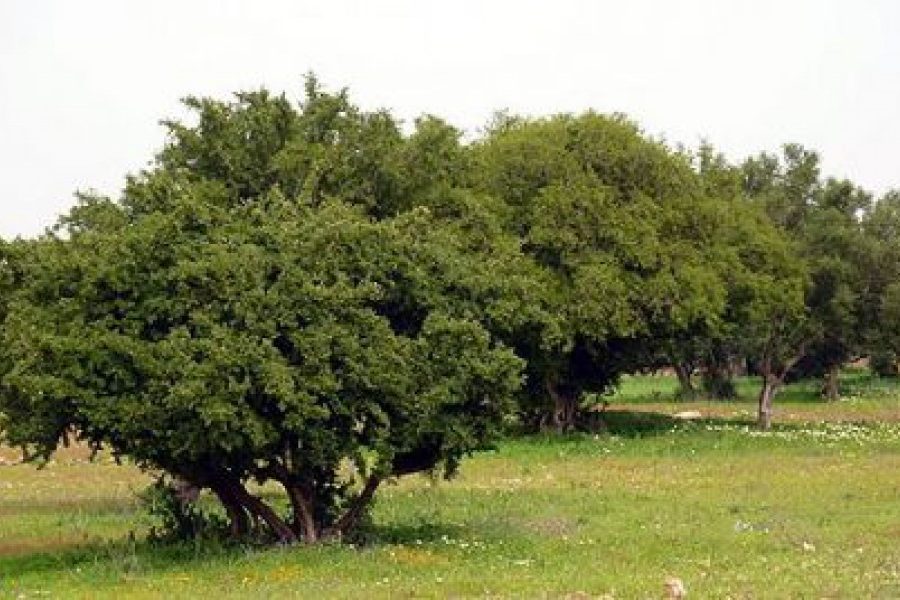
In fact, the argan tree from which the oil comes has a story more magical than even the marketing genies can invent, beginning 15 to 25 million years ago.
Argan trees were spreading their thorny branches across what is now Morocco before humans had learned how to make fire, in fact before homo sapiens even existed. A single argan tree, living from 125-400 years, can witness the arrival and departure of whole villages – even the rise and fall of empires.
The argan tree’s ability to survive harsh conditions means that it helps stave off desertification in regions bordering the Sahara. It can survive years of catastrophic drought by shedding all its leaves, relying on two different types of root to absorb both the sparsest rainfall and the deepest flowing groundwater.
To this day, the olive-shaped yellow argan fruits provide hanging pasture for goats and camels; its flowers impart a delicate flavor to the honey made by local bees, and its pulverized seeds yield a nourishing golden oil.
Until recently, those living in regions where argan trees grow practiced the traditional methods of using the tree. Village goats and camels have always grazed freely on the leaves and fruits. Local women have harvested the nuts, and sorted, dried, hulled, toasted, ground, milled and mixed them communally, using the same tools and techniques their grandmothers and great-grandmothers used, and singing folk songs to make the work pass more quickly. The golden oil has served as food, as a treatment for skin and hair, and as a gift for brides.
Yet the many uses of this “living fossil” seem to generate an equal number of threats to its continued existence. During the colonial period, overuse for wood destroyed groves that were once plentiful, stretching all along the Atlantic coast from Tiznit to Safi. Now, overgrazing by goats, changing farming practices, population growth, and climate change also ratchet up the pressure.
International interest soon followed, bringing with it new challenges. According to Moroccan government data, the country’s exports of argan oil have more than doubled in the past years, much of which has gone to skin- and hair-care product makers.
Although modern processing techniques have increased the yield in oil per tree, global demand can far exceed the groves’ million and a half acres of production capacity. For argan forests to be re-planted, tender seedlings need the cover afforded by other thorny native species, like sumac and ziziphus, which are also threatened by monoculture.
Under the leadership of His Majesty King Mohammed VI, the government has already taken the step of voting Argan a “Protected Geographical Indication” and obtained recognition of International Argan Day (May 10th) by the United Nations. In 2014 already, UNESCO inscribed the argan and the traditional practices surrounding its use in the Representative List of the Intangible Cultural Heritage of Humanity. These efforts will enhance recognition and appreciation of the tree around the world.
From the UN headquarters in New York to Agadir and elsewhere, the annual celebration this Monday would pay due attention to an agro-forestry-pastoral system with its outstanding landscapes that combine agricultural biodiversity, resilient ecosystems and a valuable cultural heritage.






add your comment
Terms of publication : Not to offend the writer, people, sacred things, or attack religions or the divine self, and refrain from racist incitement and insults.