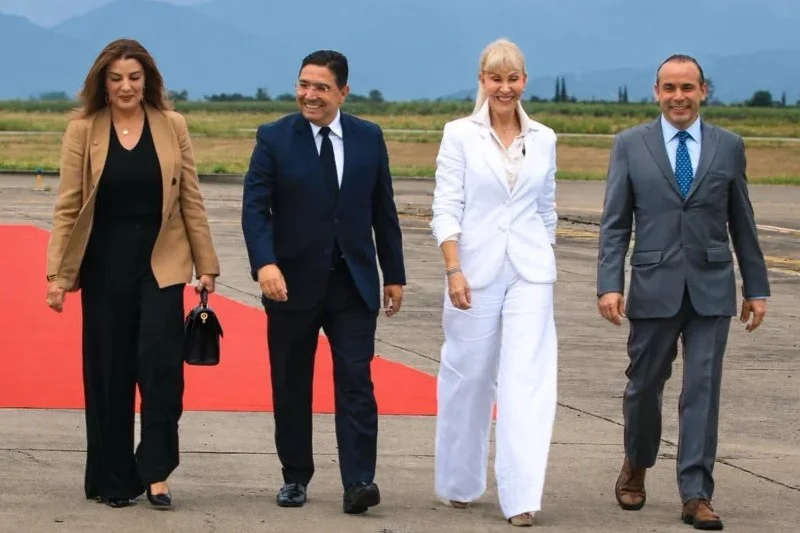
Moroccan and Latin American affairs experts have welcomed Colombia’s recognition of Morocco’s sovereignty over the Sahara, saying the decision could have implications beyond diplomacy and help open new opportunities for economic, investment and strategic cooperation between Rabat and Bogotá.
The move, described by Moroccan academics as one of the first major foreign policy decisions of Colombia’s new leadership, could create new momentum in bilateral relations while strengthening Morocco’s broader engagement with Latin America.
Mohamed Atif, a professor of international relations at Chouaib Doukkali University in El Jadida who specializes in Latin American affairs, described Colombia’s position as an important milestone in Morocco-Colombia relations.
The decision reflects not only a shift in Bogotá’s position on the Sahara but also a broader change in the nature of relations between the two countries, Atif told Hespress AR.
He said Colombia’s clear position on Morocco’s territorial integrity could create a new political environment and encourage Rabat and Bogotá to reconsider their bilateral priorities.
Atif said Morocco should view the development not simply as a diplomatic gain but as an opportunity to expand political dialogue, trade and investment, as well as cooperation in agriculture, energy, industry, tourism, education and scientific research.
“The real objective is to turn political convergence into shared interests that give Morocco-Colombia relations a more sustainable foundation,” he said.
From political convergence to economic interests
Atif also highlighted Colombia’s influence in Latin America, arguing that the country is more than a bilateral partner for Morocco.
Closer relations with Bogotá could strengthen Morocco’s presence in Latin America as the kingdom expands partnerships with emerging economies, he said.
Morocco could also offer Colombia a gateway to Africa and Europe, giving the relationship a broader Atlantic dimension, according to Atif.
“The real value of this shift will be seen in how it is used in the coming period,” he said. “Political recognition is an important step, but its real strength lies in the partnerships, projects and shared interests that can be built on it.”
If Morocco and Colombia succeed in translating their political convergence into deeper economic, institutional and cultural cooperation, Atif said, the relationship could move from one previously affected by political differences toward a partnership based on trust and mutual interests.
He said such a development would give Morocco an opportunity to strengthen its position in Latin America and reinforce its role as an Atlantic actor rather than focusing solely on securing diplomatic support for its position on the Sahara.
Experts see broader strategic potential
Mohamed Naciri, head of the Ibn Rochd Center for Geopolitical Studies and Policy Analysis and a professor of international relations at the University of Marrakech, said Colombia’s renewed recognition of Moroccan sovereignty over the Sahara demonstrates Morocco’s ability to adapt its international alliances to political changes.
He said the decision, which came under Colombia’s newly installed government, was particularly significant given the different approach taken by the country’s previous left-wing administration.
According to Naciri, Colombia’s previous government maintained relations with the Polisario Front, while the new administration has explicitly reaffirmed Morocco’s position on the Sahara.
He described the development as evidence of the effectiveness of Moroccan diplomacy and its ability to respond to changes in the international political landscape.
Naciri also emphasized Colombia’s importance as a major South American country with significant economic and strategic potential.
He argued that the latest position could elevate bilateral relations toward a more strategic level by creating opportunities for cooperation based on the capabilities and interests of both countries.
He pointed to several Moroccan initiatives and projects aimed at strengthening economic and strategic partnerships across Africa, including the royal initiative to provide Sahel and Sahara countries with access to the Atlantic, the African Atlantic initiative and the Nigeria-Morocco gas pipeline project.
Naciri said these initiatives could provide additional avenues for cooperation between Morocco and Colombia.
He added that Colombia’s current leadership understands Morocco’s economic and strategic potential and its ability to engage on regional and international issues, creating opportunities for a longer-term partnership.
Despite periods in which bilateral relations have been influenced by ideological changes in Colombia’s successive governments, Naciri said, ties between the two countries remain grounded in established foundations.
He described Colombia’s latest position as an additional boost to the growing number of international positions supporting Morocco’s stance on the Sahara and said it could contribute to the kingdom’s broader diplomatic momentum.





add your comment
Terms of publication : Not to offend the writer, people, sacred things, or attack religions or the divine self, and refrain from racist incitement and insults.