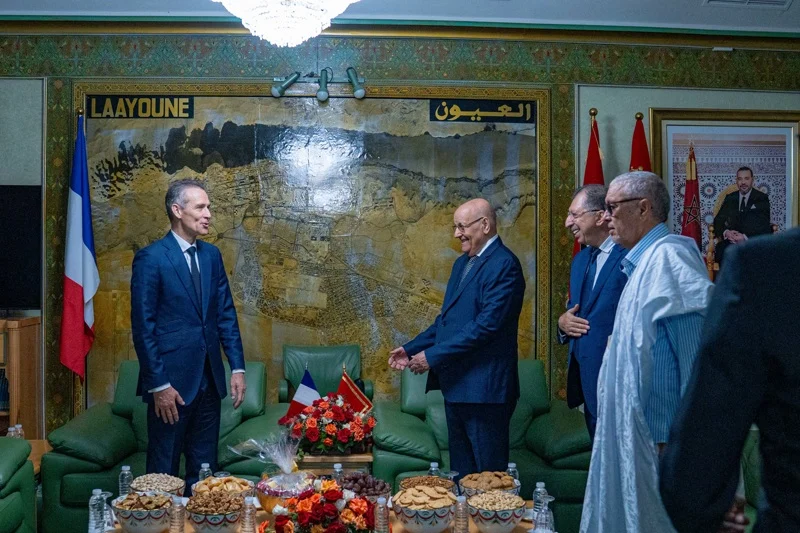
France’s newly appointed ambassador to Morocco, Philippe Lalliot, made his first official visit to Laayoune on Wednesday, describing the trip as a reflection of Paris’ commitment to Morocco’s southern provinces and its intention to deepen economic and institutional cooperation under the two countries’ strategic partnership.
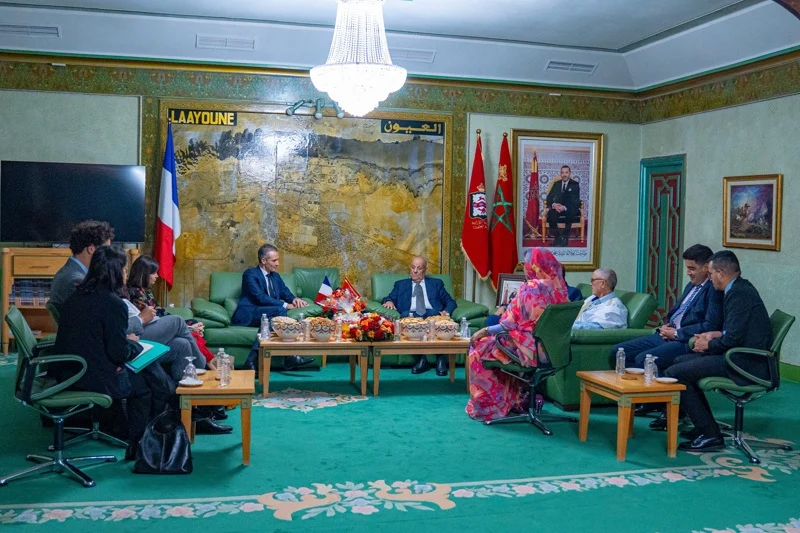
During separate meetings with Laayoune-Sakia El Hamra regional governor Abdesslam Bekrate and Laayoune Mayor Moulay Hamdi Ould Errachid, Lalliot said France intends to maintain its engagement in the region by supporting development projects, encouraging investment and promoting stability.
He said the visit comes amid renewed momentum in Moroccan-French relations following French President Emmanuel Macron’s letter to King Mohammed VI reaffirming France’s support for Morocco’s autonomy proposal as the “serious, credible and realistic” basis for resolving the Sahara dispute.
Lalliot said France has consistently supported Morocco’s autonomy initiative since it was presented in 2007 and has defended that position within the U.N. Security Council.
The ambassador said his visit also forms part of efforts to implement commitments arising from the enhanced partnership between Rabat and Paris, including preparations for future bilateral meetings, implementation of a new framework agreement and an anticipated royal visit aimed at further strengthening ties.
France views Morocco’s southern provinces as a strategic area for investment and production, Lalliot said, adding that French companies are being encouraged to participate in major infrastructure, renewable energy, blue economy, education and vocational training projects planned for the region.
“The next decade will be decisive in establishing the southern provinces as an economic hub linking Europe with Africa,” he said.
Lalliot said discussions with local officials focused on major development programs already underway as well as future investment opportunities that could generate economic value and employment.
On the Sahara issue, the ambassador said growing international support for Morocco’s autonomy initiative could create new momentum for the U.N.-led political process.
He expressed hope that negotiations would eventually produce a lasting political solution based on Morocco’s autonomy proposal under Moroccan sovereignty.
The meetings also addressed the future of the U.N. peacekeeping mission in the Sahara (MINURSO), the ceasefire and humanitarian issues concerning residents of the Tindouf camps in Algeria, including prospects for their return should a final political settlement be reached.
Lalliot also participated in the inauguration of the new Alliance Française center in Laayoune, describing it, alongside the Paul Pascon French International School, as evidence of the two countries’ shared commitment to investing in education, youth and cultural cooperation.
He said the cultural center would promote the French language while expanding educational and academic opportunities for young people in the region.
Bekrate welcomed the ambassador’s visit, calling it a concrete expression of the longstanding relationship between Morocco and France.
He said the visit would help strengthen economic and investment cooperation in Morocco’s southern provinces in line with King Mohammed VI’s development strategy for the region.
Bekrate also referred to what he described as a new chapter in bilateral relations following President Macron’s recent state visit to Morocco, saying the agreements reached provide a new framework for diplomatic cooperation.
Mayor Ould Errachid likewise welcomed the French delegation, saying the visit reflects the positive momentum in Moroccan-French relations and praising France’s support for Morocco’s territorial integrity and autonomy proposal.
During the meeting, Ould Errachid outlined the region’s historical ties to Morocco, reviewed development projects carried out in the southern provinces and presented investment opportunities linked to the region’s infrastructure and strategic location as a gateway to sub-Saharan Africa.
He reiterated that Morocco’s autonomy initiative under Moroccan sovereignty remains, in his view, the only viable solution to the Sahara dispute.
Responding to questions about residents of the Tindouf camps, Ould Errachid argued that the Polisario Front does not represent the majority of Sahrawis and said Morocco has developed the institutional and humanitarian capacity to facilitate reintegration while preserving stability and protecting rights.
He also said MINURSO’s mandate is limited to monitoring the ceasefire, accusing the Polisario Front of violating the agreement in 2020 during the Guerguerat border crossing crisis.
Ould Errachid said growing international backing for Morocco’s autonomy proposal demonstrates that alternative approaches have failed to produce a solution to the decades-long dispute.




add your comment
Terms of publication : Not to offend the writer, people, sacred things, or attack religions or the divine self, and refrain from racist incitement and insults.