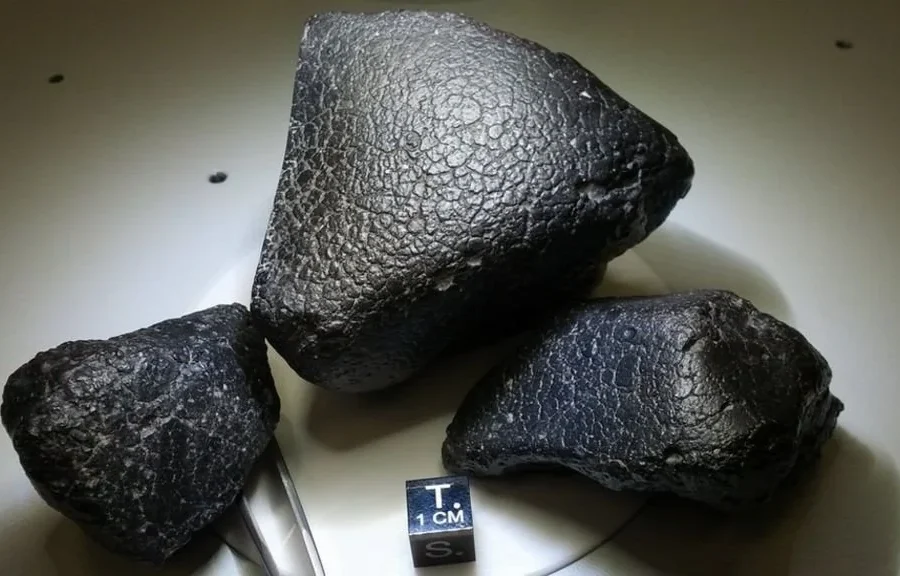
A fragment of Mars found in Morocco’s Sahara more than a decade ago has yielded its most precise look yet at water locked inside the planet’s ancient crust, using a scanning technique that for the first time mapped hydrogen through the rock without destroying any part of it.
In a study posted in January, researchers at the Technical University of Denmark and the University of Copenhagen used a novel combination of neutron and X-ray scanning to produce the first complete, three-dimensional map of water distribution inside the rock.
They found that its water content measured approximately 6,000 parts per million, far exceeding concentrations recorded in earlier Martian meteorites.Water is not spread evenly through the meteorite but locked in highly concentrated pockets within ancient igneous fragments, clusters so small they make up less than half a percent of the sample yet account for roughly 11 percent of its total water content.
The rock itself, now known as the Black beauty, was spotted in 2011 by nomads crossing the Sahara in the Rabt Sbayta region of southern Morocco, an area that has become one of the world’s most productive hunting grounds for meteorites, owing to the desert’s flat, dark-rock-free terrain that makes space debris easier to identify.
The stone, barely the size of a fist and weighing around 320 grams, was sold through Morocco’s informal meteorite trade and eventually reached an American collector, who made it available to researchers at the University of New Mexico.
When scientists there examined it in 2013, they realized it matched no known category of Martian meteorite. Unlike the vast majority of Martian rocks that reach Earth, which originate from relatively young volcanic activity deep within the planet, this one had come from the ancient surface crust, and it was saturated with water.
The technique behind the latest findings, which bombards the rock with neutrons rather than electromagnetic radiation, detects hydrogen directly, something no previous method had achieved at a whole-sample scale.
Earlier water estimates relied on indirect inference from thin sections cut from the meteorite’s surface, a process that consumed part of an irreplaceable specimen and offered only a fragmentary picture.
Mars today is a frozen desert, its surface stripped of liquid water and its thin atmosphere offering little protection from solar radiation. But mounting evidence points to a dramatically different early history, one in which liquid water carved river valleys, filled crater lakes, and persisted at the surface for potentially millions of years.
The mineral assemblages the researchers identified inside the Moroccan meteorite closely mirror materials collected by NASA’s Perseverance rover in Jezero Crater, a dried lakebed now being combed for signs of ancient microbial life, suggesting the water-rock interactions preserved in this desert find were not a local anomaly but a defining feature of early Mars.
With NASA having suspended its Mars Sample Return mission, meteorites like this one remain the only direct window into Martian geology available to science. The researchers say the scanning method they developed may prove just as valuable when those samples eventually make it back to Earth.




add your comment
Terms of publication : Not to offend the writer, people, sacred things, or attack religions or the divine self, and refrain from racist incitement and insults.