
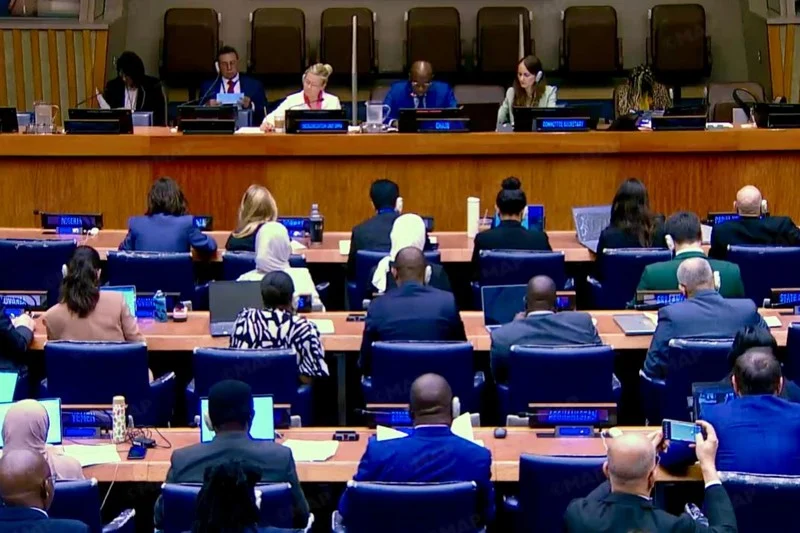
The version of the draft resolution to be voted on tonight by the United Nations Security Council confirms, for the first time in explicit language, that Morocco’s 2007 Autonomy Proposal constitutes “a most feasible” solution for the Sahara, according to the final text obtained by Hespress EN.
The document, drafted by the United States and circulated in its clean version on October 30, renews the mandate of the MINURSO until October 31, 2026 and formally integrates the Moroccan plan as the reference framework for negotiations.
The draft opens with standard reaffirmations of prior resolutions and reiterates support for Secretary-General António Guterres and his Personal Envoy Staffan de Mistura.
But the language then departs sharply from precedent: the Council takes note of “the support expressed by many Member States for Morocco’s Autonomy Proposal … affirming that genuine autonomy under Moroccan sovereignty could constitute a most feasible solution.”
The wording merges two once-separate concepts, self-determination and autonomy, into a single formulation that anchors the negotiation process around Morocco’s 2007 plan.
In operational terms, the resolution directs the Secretary-General and his Envoy “to facilitate and conduct negotiations taking as basis Morocco’s Autonomy Proposal,” welcomes “any constructive suggestions by the parties in response to the Autonomy Proposal,” and calls on Morocco, the Polisario Front, Algeria, and Mauritania to “engage in these discussions without preconditions.”
It further “recognizes that genuine autonomy could represent a most feasible outcome” and encourages the parties to submit additional ideas toward a final agreement.
The Council invites member states to lend assistance and explicitly thanks the United States for its readiness to host future rounds of negotiations.
These formulations collectively mention Morocco’s Autonomy Proposal four times and reiterate the “genuine autonomy” phrase twice, both a quantitative and rhetorical escalation from previous years’ resolutions, which confined autonomy language to preambular references.
In this draft, autonomy becomes the foundation of the operative section itself, shifting from acknowledgment to prescription while “self-determination” remains only within the general reference.
The document also expands MINURSO’s renewal to a full year and introduces, for the first time, a requirement that within six months of renewal the Secretary-General present a “strategic review regarding MINURSO’s future mandate.”
That review must consider “the outcome of the negotiations,” effectively linking the mission’s continuation to measurable political progress.
Humanitarian provisions are maintained, with the Council noting “with deep concern the insufficient funding for the Sahrawi refugees” in the Tindouf camps and “strongly encourages donors to provide additional funds while reiterating its requests for refugee registration.”
It also underlines the importance of “respecting the ceasefire and avoiding any act that jeopardizes the political process.” While familiar in tone, these paragraphs position humanitarian support within the same structure that privileges progress under the autonomy track.







add your comment
Terms of publication : Not to offend the writer, people, sacred things, or attack religions or the divine self, and refrain from racist incitement and insults.