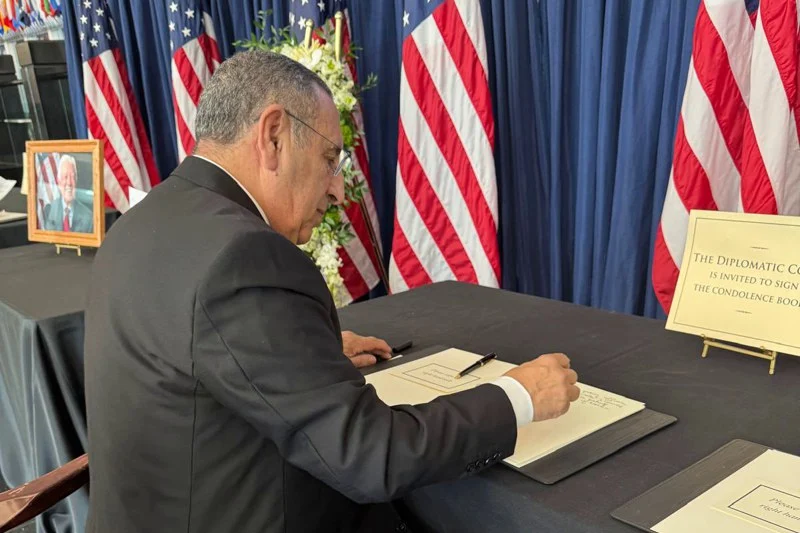
A recent opinion piece published on JFeed, a U.S.-based media outlet focused on Israel and the Jewish world, has sparked widespread backlash in Morocco for what critics call an “unfounded and dangerous attack” on the country’s ambassador to the United States, Youssef Amrani.
The article, titled “Is an Anti-Semitic Family Representing Morocco in Washington?”, was written by Moroccan-American activist Mustapha Zarghani, who heads the Moroccan-Israeli Friendship Association in the U.S. It criticizes Amrani and his wife, Moroccan intellectual and scholar Asma Lamrabet, alleging their lack of engagement with pro-Israel groups and accusing them of anti-Semitism.
The piece, which reportedly defends grievances by extremist Zionist activists over not being received by Amrani, conflates opposition to Israeli military actions in Gaza with anti-Jewish sentiment, according to Moroccan analysts and human rights advocates.
Khalid El Bekkari, a Moroccan human rights activist and professor, described JFeed as a right-wing religious Zionist platform launched in 2023 by Eli Kotelev.
“This article is an act of incitement against Ambassador Amrani and his wife, published on a platform that is part of the broader pro-Israel lobby in the U.S.,” El Bekkari said. “The article undermines the professionalism of Morocco’s top diplomat in Washington and indirectly questions the judgment of the royal palace and national security institutions.”
He added that figures like Zarghani are emboldened by what he sees as lax domestic oversight. “They believe they are above reproach because of their ties to Israel, but the real failure lies in those who gave them a platform and legitimized their activities.”
Moroccan political scientist Omar Cherkaoui also condemned the article, emphasizing that Amrani was appointed by King Mohammed VI under Article 55 of the Constitution.
“Attacking the ambassador with accusations of anti-Semitism is an attack on Morocco itself,” he said. “Morocco’s relationship with Judaism is historical and enshrined in our Constitution.”
Mohamed Cherkaoui, a Moroccan academic based in the United States, criticized the article as intellectually shallow and politically motivated.
“This is a character assassination attempt masquerading as journalism,” he said. “The article reads more like an inquisition, targeting independent thought and labeling criticism of Israeli policy as anti-Semitic.”
Cherkaoui also condemned the targeting of Lamrabet, a renowned scholar and member of Morocco’s Royal Academy. “This is not a legitimate critique,” he said. “It’s a personal attack rooted in ideological bias, wrapped in vague accusations that wouldn’t meet the editorial standards of credible outlets like The Washington Post or Foreign Policy.”
Latifa El Bouhsini, a political activist and academic, added: “Waving the anti-Semitism card in the face of a Moroccan diplomat by one of our own is not only intellectually lazy, it’s a betrayal. There are enemies of Morocco operating from within.”
The Moroccan government has not yet issued an official response. However, observers say the article is unlikely to affect Amrani’s standing, given his record and the strategic nature of Rabat’s relations with both Washington and Tel Aviv.
Morocco normalized relations with Israel in 2020 as part of the U.S.-brokered Abraham Accords. While the decision was welcomed by some, it has remained a deeply polarizing issue domestically, with vocal opposition from political and civil society groups who draw a line between engaging diplomatically and endorsing Israeli policies.







add your comment
Terms of publication : Not to offend the writer, people, sacred things, or attack religions or the divine self, and refrain from racist incitement and insults.