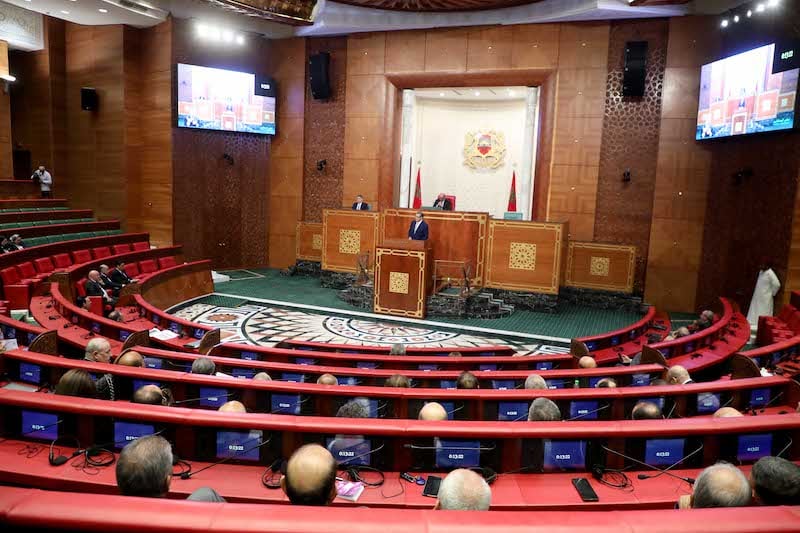
Morocco’s opposition parties and labor unions delivered a scathing critique of the government’s economic and fiscal policies on Tuesday, claiming they have failed to translate into real improvements for citizens.
Speaking during a monthly session in the House of Councillors dedicated to evaluating the country’s investment and employment performance, critics cited rising precarious employment, missed development goals, and widening regional inequalities.
“Hollow Growth” and Fragile Jobs
Representatives from opposition groups and labor federations warned that while macroeconomic indicators show positive trends, these gains have not trickled down. “The government’s policies have generated precarious jobs and opportunistic private investment that relies heavily on public contracts without creating sustainable employment,” said Nabil El Yazidi, a member of the Haraki group.
He criticized the government for rushing to implement regulations favoring large corporations under the new investment charter, while delaying support mechanisms for small and medium-sized enterprises (SMEs), which constitute over 90% of Morocco’s business fabric. “Relevant legal texts for SMEs were only issued on July 3, 2025,” he noted.
Missed Regional Development and Persistent Inequality
Ismail Alaoui of the Socialist Union of Popular Forces (USFP) lamented the lack of spatial equity in the distribution of investments and wealth, stating: “Regions such as the southeastern provinces remain marginalized, driving youth migration and undermining local stability.” He cited the example of Drâa-Tafilalet, which he said suffers from dilapidated infrastructure and lack of economic opportunities.
Rising Unemployment and Labor Rights Violations
Noureddine Selik, head of the Moroccan Labor Union group, highlighted rising unemployment, especially among diploma holders, and warned of deteriorating job quality. “Most newly created jobs are temporary or insecure,” he said. He accused employers of flouting labor laws in broad daylight, including violations of minimum wage requirements, social security registration, working hours, and occupational safety standards.
He called for a “Social Charter for Investment”, rooted in a tripartite dialogue, to ensure that investors respect workers’ rights and to incentivize job-creating investments in disadvantaged regions through tax and land measures—not by tolerating “social evasion.”
Doubts Over the New Investment Charter and Government Promises
Other labor representatives echoed skepticism over the real impact of the government’s signature programs. Lahcen Nazih from the Democratic Confederation of Labor (CDT) argued that economic growth has remained structurally weak, relying on short-term factors such as a good agricultural season or increased remittances. “In 2025, youth unemployment, especially among graduates, has continued to rise,” he said.
Nazihe questioned the effectiveness of the New Investment Charter, dismissing it as hype without tangible outcomes. “Private investment remains below one-third of total national investment and is largely dependent on public procurement,” he said.
Khalid Satti from the National Union of Labor in Morocco (UNTM) challenged the government on the fate of several promised programs. “Where is the government’s pledge to create one million jobs? Or to raise female labor participation to 30%—we’re still stuck at 20%,” he said. He also asked about the status of the “Karama income” initiative for senior citizens.
While acknowledging that the government has undertaken significant financial efforts and even raised wages, Satti noted lingering discontent across key sectors, including engineers and educators. “You increased salaries, but not enough, and you left out retirees,” he concluded.



add your comment
Terms of publication : Not to offend the writer, people, sacred things, or attack religions or the divine self, and refrain from racist incitement and insults.