
In the fast-changing Sahel-Saharan region, and as traditional French influence declines, Morocco is emerging as a pivotal player that is not content to simply follow events, but also participates in shaping the characteristics of the new regional order, according to a visionary and forward-looking royal vision.
The Maghreb and African region is experiencing profound dynamics that are reshaping regional and international balances. In this context, Morocco continues to pursue an active and intelligent diplomacy, led by His Majesty King Mohammed VI, based on a vision of cross-border development that values regional cooperation and considers security and stability to be key factors in sustainable development.
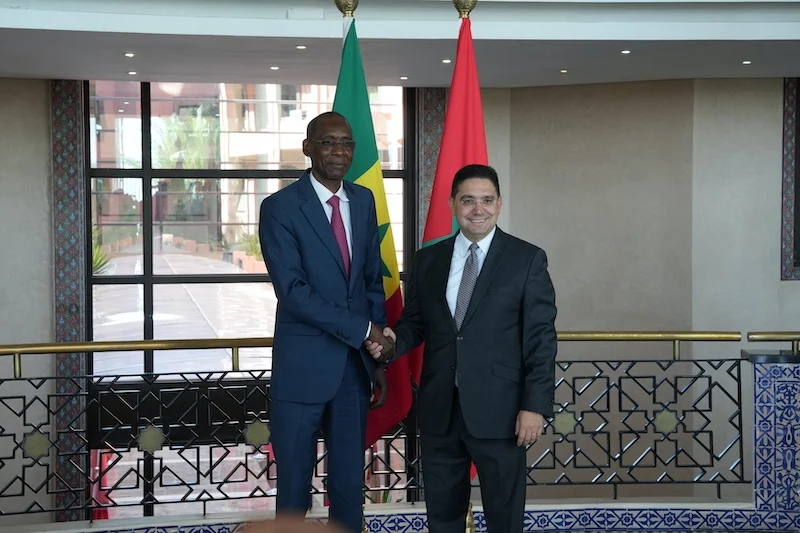
The meeting between His Majesty the King and the foreign ministers of Mali, Burkina Faso and Niger confirms the proactive dimension of the Moroccan initiative, at a time when the region is confronted with repeated attempts to form alternative blocs, such as the Algiers summit that brought together Tunisia and Libya. This royal meeting is not simply a diplomatic response, but the expression of a strategic action that focuses on building rational alliances for a promising future.
Morocco’s strong relations with the European powers, particularly France and Spain, reinforce this trend, as these countries more clearly and consistently support the Sahara autonomy initiative. On the other hand, Algerian diplomacy seems to be caught between a Northern Europe that supports the Moroccan vision and a South Africa that is increasingly open to the development approach proposed by Morocco.
In this geostrategic movement, new challenges are arising from the void left by France’s disengagement from its traditional zones of influence, while international powers such as Russia, China and Turkey are attempting to fill this gap by developing their relations with the African continent and organizing strategic partnership summits with it.
In this context, Morocco presents itself as a rising regional figure that does not seek to dominate or impose its influence, but rather to support South-South cooperation, which has been the backbone of the kingdom’s African policy over the past two decades.
Today, the Atlantic coast is of growing strategic importance. The southern provinces have become Morocco’s gateway to the African continent and its window on the Atlantic, as well as a new cornerstone of geographic and economic connectivity with Europe and the Americas.
The Atlantic Initiative, announced by King Mohammed VI, aims to give Sahel countries access to the Atlantic Ocean by linking their infrastructures to Morocco’s advanced port, road and rail networks. This initiative is not limited to economic considerations; it is part of an integrated geostrategic project that will break isolation, promote regional integration and consolidate South-South solidarity.
This initiative confirms the depth and farsightedness of the royal perspective, and reflects the dynamism and effectiveness of Moroccan diplomacy under the leadership of the Minister of Foreign Affairs and African Cooperation, Mr. Nasser Bourita, who has succeeded in raising the profile of royal initiatives in international forums, particularly with regard to the autonomy proposal as part of a political process that enjoys growing support.
The Dakhla Atlantic port project is one of the main pillars of this initiative, along with the motorway network, logistics platforms and electricity interconnection projects, all of which reinforce Morocco’s position as the economic powerhouse of the Sahel and West Africa.
Morocco’s dynamism is not confined to diplomatic aspects, but extends to the security and economic levels, where it is establishing itself as a major contributor to efforts to combat terrorism as part of the international strategy led by the United States. This new positioning confirms the effectiveness of the Moroccan approach, which combines political wisdom with economic efficiency.
The era of Moroccan voluntarism is over, the era of Moroccan voluntarism is beginning.
The Atlantic initiative is a new episode in a series of strategic initiatives that reinforce Morocco’s presence in Africa, and reflect a royal vision that foreign policy should be placed at the service of development, and that geography can be transformed into a space for integration rather than conflict.
Geopolitical issues should not be confronted with slogans or short-term positions, but with a long-term strategic vision, as Morocco is doing today. When politics becomes a lever for development, we have a country worthy of its king’s vision.

add your comment
Terms of publication : Not to offend the writer, people, sacred things, or attack religions or the divine self, and refrain from racist incitement and insults.