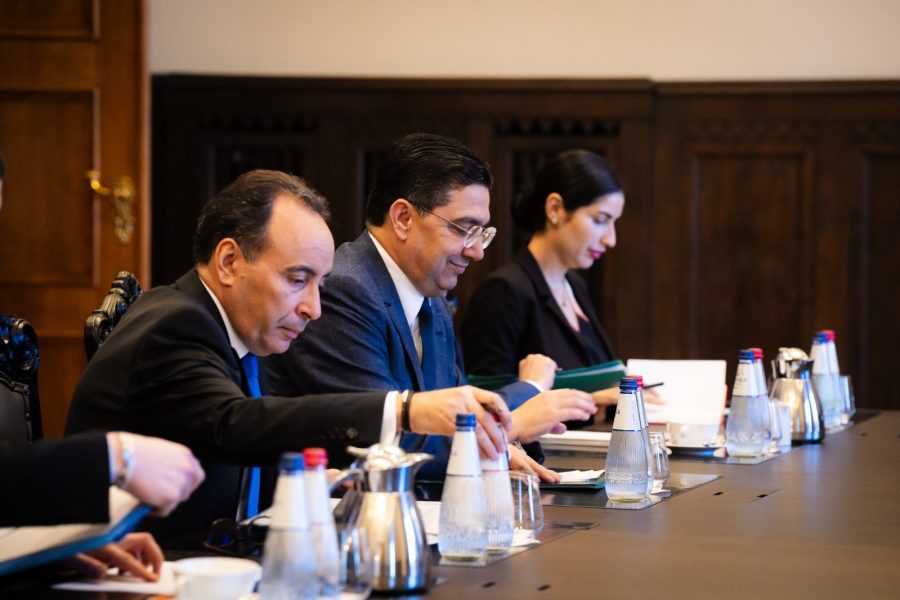
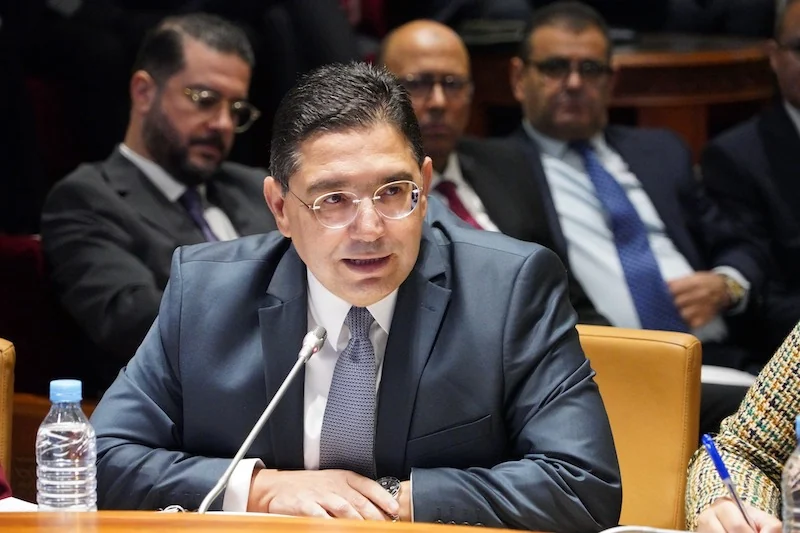
As developments around the Sahara dispute gain international traction, Moroccan Foreign Minister Nasser Bourita has intensified a diplomatic offensive across key global capitals, reflecting Rabat’s strategic push to consolidate support for its autonomy plan under UN auspices.
Bourita’s whirlwind tour has taken him from Washington, Paris, and Madrid to capitals in Central and Eastern Europe—including Slovenia, Hungary, Estonia, Moldova, and Croatia—where he met with foreign ministers and officials to strengthen bilateral ties and advance Morocco’s position on the Sahara.
His latest stop in Slovenia, a non-permanent member of the UN Security Council, saw discussions with Deputy Prime Minister and Foreign Minister Tanja Fajon focused on the Moroccan autonomy initiative and evolving Security Council dynamics. The visit coincided with a new briefing by UN envoy Staffan de Mistura to the Security Council, which praised Morocco’s “serious and constructive cooperation” and hinted at emerging consensus grounds for political progress.
This diplomatic momentum comes as Rabat seeks to broaden its base of regional and global support, presenting its autonomy plan as the only viable solution. Analysts say the strategy marks a shift from passive diplomacy to proactive engagement designed to reshape international consensus.
Strategic Shift and European Realignment
Ibrahim Bellali Essouih, a member of Morocco’s Royal Advisory Council for Saharan Affairs, described Bourita’s seven-country tour in five days as a “qualitative leap” that aligns with royal directives urging accelerated defense of Morocco’s strategic interests. He emphasized that Morocco is no longer waiting for global reactions but is now “leading from the front” to impose its pragmatic approach to the territorial dispute.
Essouih also interpreted De Mistura’s latest UN briefing—which sidelined the referendum option—as a diplomatic win for Morocco and a blow to the Algeria-backed separatist narrative. He noted increasing political backing from European capitals like Paris, Madrid, Tallinn, and Budapest, pointing to a continental pivot toward Rabat’s position.
Europe’s evolving stance, he added, now hinges on strategic partnership logic, particularly in security and defense, with Morocco seen as a stabilizing actor in the southern Mediterranean and a key NATO partner in deterring regional threats.
Global Stakes and Algeria’s Dilemma
The Moroccan push includes a geostrategic component, Essouih said, leveraging the southern provinces as investment hubs and gateways to broader African cooperation, especially under growing interest in South Atlantic cooperation. He warned that Algeria faces rising pressure to adapt or risk isolation, citing U.S. research reports linking the Polisario Front to Iran and Hezbollah, with mounting calls to designate it a terrorist organization.
Toward a Decisive Phase
According to Essouih, Bourita’s stops in the U.S. and Slovenia signal Morocco’s deep awareness of shifting global dynamics and its ability to forge “win-win” alliances. With increasing international endorsement for the autonomy plan, he predicted the conflict may be entering a decisive phase, particularly as separatist arguments lose resonance and the UN aligns more closely with realistic solutions.
Soft Power and Pragmatism
Khalid Cheyhat, a professor of international relations at Hassan I University in Oujda, echoed these sentiments, describing Morocco’s approach as a “quiet and pragmatic diplomacy” rooted in historical legitimacy and mutual respect. He praised the minister’s European tour as evidence of Morocco’s capacity to rebuild regional alliances with balance and foresight.
Cheyhat noted that growing international recognition of Morocco’s sovereignty is reflected in the opening of consulates in Western Sahara and the clear shift in diplomatic language. Meanwhile, pro-separatist states are increasingly constrained by internal challenges, limiting their ability to advocate militarized or unrealistic alternatives.
He concluded that Morocco’s autonomy plan continues to gain traction because it aligns with the global trend toward practical, negotiated solutions—while the absence of a coherent counterproposal from Algeria further complicates any progress toward serious negotiations.
As diplomatic efforts intensify and the UN process regains visibility, Morocco is poised to capitalize on new geopolitical realities and international goodwill to advance a solution rooted in autonomy, stability, and regional cooperation. The next stages of UN engagement will likely test the durability of this momentum—and whether Rabat’s pragmatic push will yield lasting political resolution.


add your comment
Terms of publication : Not to offend the writer, people, sacred things, or attack religions or the divine self, and refrain from racist incitement and insults.