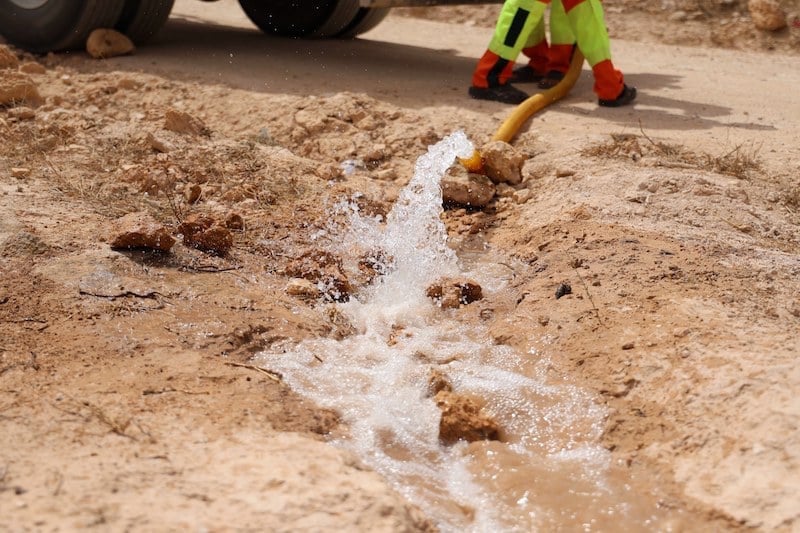
A major seawater desalination project in the Casablanca-Settat region has been marred by allegations of fraudulent technical inspection reports, Hespress AR has learned from well-informed sources.
The controversy centers on a subcontracted company responsible for technical monitoring and auditing, which allegedly requested a construction and public works laboratory to issue reports approving completed work without prior inspections or field verification by engineers and technicians.
Fabricated Reports on Key Construction Elements
The questionable reports reportedly pertain to crucial aspects of the project, including excavation reception tests (Réception des fonds de fouilles), concrete formulation (formulation des bétons), and concrete quality control tests such as slump, compressive strength, tensile strength, and density.
Additionally, core sample extraction (essais de carottage sur béton) from the concrete was also included in the alleged fraudulent documentation.
According to sources, the laboratory technicians refused to issue over 100 reports without conducting on-site inspections. However, emails from the subcontracted company pressured the lab to expedite the necessary reports, even highlighting the non-attendance of a technician at the project site. Despite this, work on the project continued without proper supervision.
The implicated laboratory has allegedly engaged in similar practices on other projects, providing standardized reports (rapports standard) that can be easily adapted to meet approval requirements, even without site visits or material sampling.
Desalination Pipeline Under Scrutiny
The project in question involves a 10-kilometer pipeline for seawater desalination between two cities in the Casablanca-Settat region. Its construction has been fast-tracked due to the urgent need to address drought and water scarcity.
However, industry insiders warn that lax oversight and cost-cutting measures in construction projects are a growing concern. Several public works laboratories have voiced complaints about low bidding prices, high competition, bureaucratic hurdles in classification upgrades, and delayed payment of public contracts, which have led to financial struggles and even bankruptcies.
Calls for Transparency and Stricter Oversight
Experts and industry stakeholders are urging authorities to ensure that public contracts are awarded based on quality rather than the lowest bid. They advocate for precise reference pricing, enforceable technical specifications, timely payments, and enhanced oversight to ensure project integrity.
Amid these revelations, the implicated laboratory has reportedly applied for a higher classification from the Ministry of Equipment and Water to qualify for larger public contracts. This move comes despite concerns that the firm has leveraged past project references—some potentially based on questionable reports—to gain eligibility for new tenders.
The ministry, which introduced a reclassification system for construction and public works firms in 2017 to enhance quality control, faces renewed pressure to strengthen its regulatory framework. The ongoing scandal raises broader concerns about the impact of awarding contracts to unqualified firms and the long-term consequences on project quality, cost, and safety.



add your comment
Terms of publication : Not to offend the writer, people, sacred things, or attack religions or the divine self, and refrain from racist incitement and insults.